
Before you put money or time into any web3 project, ask the uncomfortable question first: if this product stopped using the word "blockchain" tomorrow, would anyone still want it? Web3 is an idea for a new version of the internet built on decentralization, blockchains, and tokens — and some parts of that idea work today, while much of the rest is still marketing.
A blockchain is a shared digital record, kept across many computers, where entries are hard to change once made. That design genuinely solves a few problems. It also brings trade-offs: slower systems, higher costs, and new security burdens that fall on you rather than a company.
This article walks through what the term means, which web3 ideas have held up, which have not, and what that means for a newcomer deciding what — if anything — to do about it.
What does web3 actually mean?
The term is hazy even by its supporters' standards. According to Wikipedia, web3 is an idea for a new iteration of the web incorporating decentralization, blockchain technologies, tokenomics, and privacy-enhancing technologies. Ethereum co-founder Gavin Wood coined it in 2014, describing a decentralized online ecosystem built on blockchain.
The shorthand most people use comes from the web's history. Web 1.0, roughly the 1990s to 2004, was read-only: static pages you consumed. Web 2.0, from around 2004 to now, is read-write: social media, blogs, and platforms where users create content — but companies own the platforms and monetize the data. Ethereum's own educational site describes web3 as "read-write-own," a web where users hold their own assets and data instead of renting access from a platform.
That ownership promise is the core of the pitch. Whether it holds is a separate question.
Which web3 ideas actually work today?
Strip away the buzzwords and a few mechanisms have proven durable:
- Programmable money and settlement. Sending value directly between two parties without a bank intermediary works, and it works around the clock. The trade-off is that you are your own customer service department.
- Smart contracts. A smart contract is a program stored on a blockchain that runs automatically when its conditions are met. If you want the mechanics, our guide to what a smart contract is covers it in plain English. They work — but only as well as the code behind them, and buggy code has cost users real money.
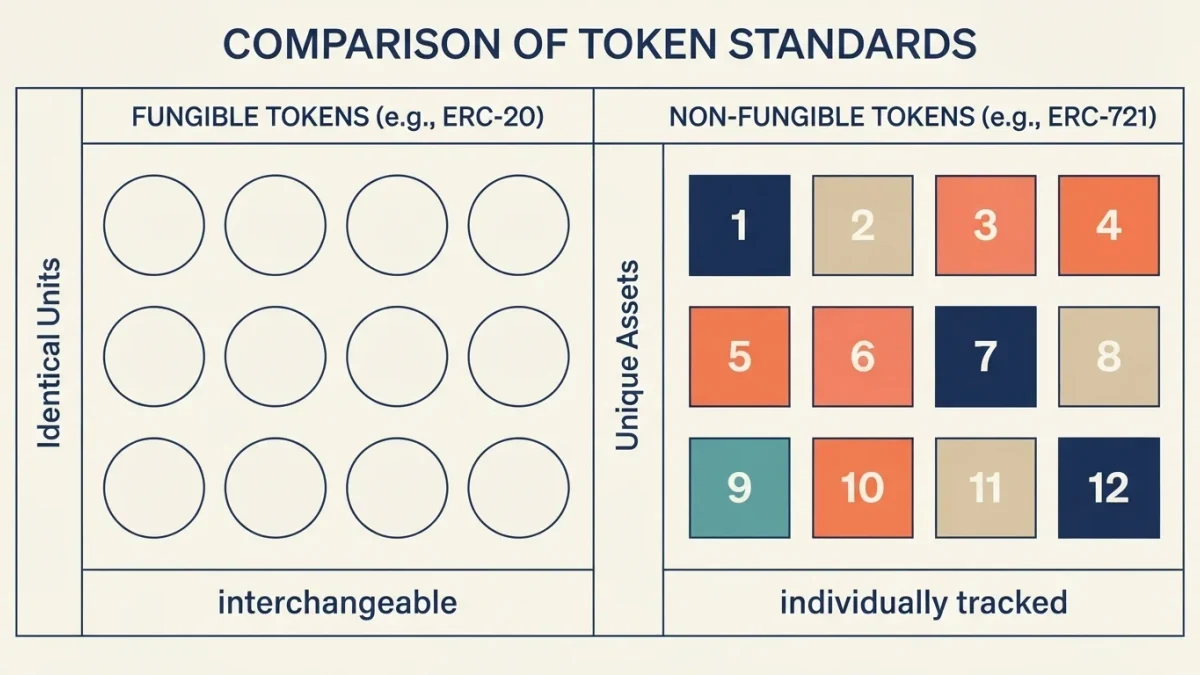
- Token standards. Shared formats like ERC-20 make assets interoperable across applications. Our explainer on token standards ERC-20 and ERC-721 explains why that plumbing matters more than most marketing admits.
- Human-readable names. Services like ENS map long wallet addresses to simple names. Our piece on what an ENS domain name is covers a small, genuinely useful piece of the stack.
Notice what these have in common: each one does a specific job. None of them needed the word "web3" to function.
Where the hype outruns reality
The gap between the vision and the product shows up in three places.
Decentralization is often thinner than advertised. Critics have pointed out that many web3 services rely on a small number of infrastructure providers, exchanges, and interfaces — meaning the new web can resemble the old one. Kevin Werbach, an ethics professor quoted in the Wikipedia article, said in 2021 that many so-called web3 solutions are not as decentralized as they seem, and have yet to prove they are scalable, secure, and accessible enough for the mass market. That is a fair summary of where things still stand.
Ownership claims need reading carefully. The pitch says you own your digital assets. What you actually own depends entirely on how the token is written. Our article on what you actually own when you buy an NFT is worth reading before believing any ownership claim.
"Decentralized" does not mean "safe." DeFi — decentralized finance, meaning lending and trading through smart contracts instead of banks — is real technology and real risk. Our DeFi basics guide covers how it works, including the ways it can go wrong. There is no deposit insurance, no reversal button, and no one to call. We covered a connected angle in DeFi basics: lending and trading without banks.
What the critics get right — and what they miss
Skeptics have their own list. Wikipedia notes that commentators including Elon Musk and Jack Dorsey have dismissed web3 as a buzzword, and that critics have raised concerns about wealth concentrating with a small group of early investors — an irony for a movement built on decentralization. Others have described it as an extension of short-lived trends like NFT speculation.
Our analysis: both sides are partly right, and the useful frame is not "web3 good or bad" but "which specific mechanism solves a specific problem." A peer-to-peer payment that settles in minutes is a real capability. A token bolted onto an ordinary app to justify a valuation is not. The technology is interesting and the risks are real, and it is fine to say both.
Practical steps before you touch any of this
If you decide to explore web3 at all, the preparation matters more than the project:
- Understand custody first. Read our comparison of custodial vs. self-custody wallets. Self-custody gives you control and makes you responsible for every mistake. Neither option is risk-free.
- Budget for costs. Transactions carry fees that change with network demand — our guide to why gas fees change explains the mechanics. Trading also has hidden costs; see our piece on what slippage costs you.
- Assume volatility. According to Wikipedia, the concept of web3 has been described as part of a cryptocurrency bubble. Nothing here is a reason to buy any of them, and no web3 token is a savings account.
- Check the security surface. Every connection between your wallet and an application is a place where things go wrong. Our security section covers the common attack patterns.
Where this leaves a newcomer
The evidence points to a split verdict. The durable parts of web3 — programmable settlement, open token standards, self-custody — are narrow tools that do real jobs. The fog around them, from ownership promises to decentralization claims, deserves the skepticism its critics apply. What remains unknown is whether the mass-market problems of scale and usability get solved; as Werbach noted, that may change, but it is not given.
The honest position for a newcomer is curiosity with a locked wallet door. Learn how the pieces work, treat every ownership and decentralization claim as a claim to verify, and never commit money you cannot afford to lose entirely.