A smart contract lives on a blockchain. It can only read what the chain itself holds. That is a real limit, because most useful triggers live outside. Prices, weather, sports scores, and delivery events all sit off-chain. A contract that cannot see the outside world cannot act on it.
A blockchain oracle is the bridge across that gap. Per Wikipedia's oracle overview, an oracle is a third-party service that provides trusted information from outside-world sources to smart contracts on the chain. The oracle wraps up the messy real-world detail and hands the contract a clean answer. That also keeps errors and points of failure easier to fix off the chain than on it. In short, the chain handles the rules, and the oracle handles the world.
A price trigger, step by step
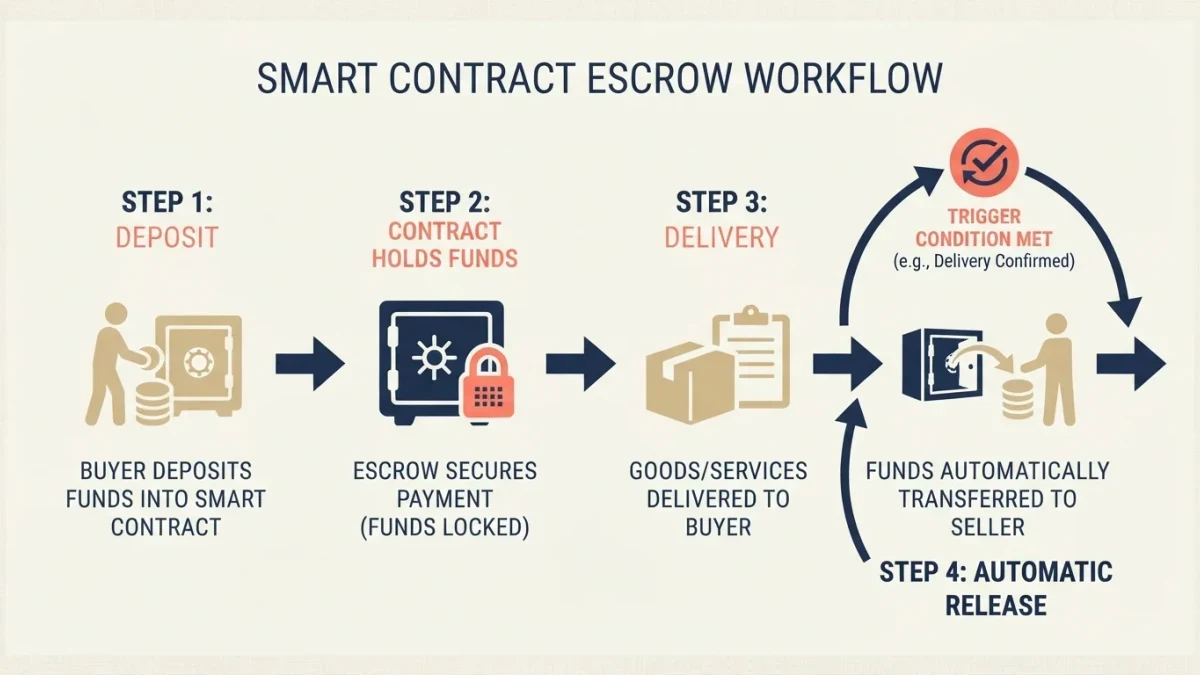
Take a contract meant to buy bitcoins at a set price. The contract cannot watch exchanges by itself. Per the Wikipedia example, its trigger depends on the current exchange rate for bitcoin, so an off-chain oracle watches the price and feeds the condition to the contract. When the rate crosses the line, the contract acts on its own. Readers following this should also see What is a smart contract?.
The main kinds of oracles
Wikipedia, citing a list from Kustov and Selanteva, names several types. A program oracle runs outside the chain and passes in data such as sports results for betting or traffic camera information for ticketing offenders. A unit oracle is built into a physical sensor, like that same camera. An entry oracle runs code stored on the chain and hands the result back as an input, such as a bitcoin price that matches a condition.
Exit oracles work the other way. They carry the result of the contract out into the world by working a real device, for example paying a fee or opening a door. Last comes the oracle agreement. It gathers answers from many oracles and settles the condition when they disagree. That last type exists because real sources often conflict. We covered a connected angle in How do Ethereum rollups work, and why do they make transactions cheaper?.
The centralization problem
If an oracle leans on one source of truth, that source becomes a weak point. Per the Wikipedia overview, a single feed can be hacked in a man-in-the-middle attack, or changed by its own owner, to sway the contracts that follow it. One bad feed can steer real money, and the contract would never know.
How decentralized oracles help, and where they stop
Decentralized oracles, also called consensus oracles, spread the trust around. They query many data sources, so no single feed decides the answer. That raises the reliability of what contracts receive. But it does not reach trustlessness. Wikipedia is direct about the limit: oracles are not part of the main chain consensus, so they sit outside the security mechanisms of public blockchains.
Why users should care
When you use a lending app, a betting market, or any contract that reacts to prices, an oracle sits in the loop. Its quality becomes part of your risk, whether or not you ever see it. If the feed is wrong, the contract is still wrong with it. Before you trust a protocol, check where its data comes from. Count how many sources stand behind each answer. Ask what happens when those sources disagree.
Conclusion: trusted data, not trustless data
Oracles give smart contracts eyes and hands. They pull prices in, and they push results out, from paying a fee to opening a door. But they add a layer of trust that the chain itself cannot check. The strongest setups query many sources, weigh the answers, and treat the oracle as a core part of the security review, not an afterthought.
This article is general information, not investment or security advice. Crypto assets are volatile and may lose all value.