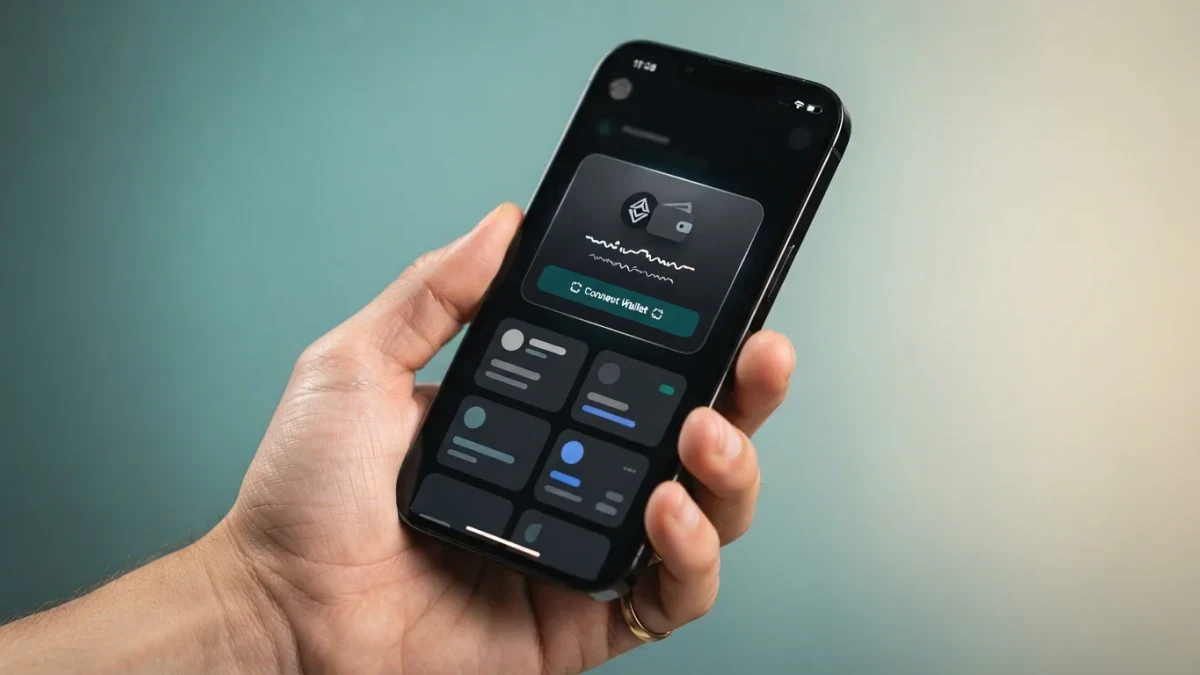

Web3 is an umbrella term for a version of the internet built on public blockchains, where you hold your accounts and assets with cryptographic keys instead of renting them from platforms. Coined by Ethereum co-founder Gavin Wood in 2014, the word covers wallets, tokens, and apps — and hides plenty of disagreement about what it should mean.
Crypto assets are volatile — they can lose most or all of their value quickly, and nothing in this article is a reason to buy any of them. With that on the table, let's unpack the word.
Where did the term Web3 come from?
The credit goes to Gavin Wood, an Ethereum co-founder, who wrote about "Web 3.0" in April 2014 — before Ethereum even launched in July 2015. His argument: after the Snowden revelations, the internet needed less blind trust in companies and more cryptography. The label stuck, then mutated.
The shorthand history goes like this. Web1 was the read-only web of the 1990s: home pages, directories, links. You looked things up. Web2, from the mid-2000s, was read-write: social platforms, video sites, app stores. You posted, uploaded, and reviewed — and the platform hosted your account, set the rules, and kept the data.
That second step created the awkwardness Web3 reacts to. Your identity on a Web2 platform is really the platform's property. It can suspend the account, change the feed, or shut down the service, and everything built on that identity goes with it.
An analogy people use: Web1 was a library, Web2 was a shopping mall, Web3 wants to be a members' co-op. Flag that as an analogy — it compresses a lot. The precise version is about control: Web3 proposes that accounts and assets be held with cryptographic keys that no intermediary can revoke.
What does "ownership" actually mean here?
In Web3, ownership means control with keys. A crypto wallet is a pair of cryptographic keys, and whoever holds the private key controls the account and whatever the network says belongs to it. No company in the middle can switch that off. That is the precise, defensible version of the slogan.
A private key is the secret code that controls a wallet. Hold it, and the blockchain treats you as the owner of whatever that address holds. This works because a public blockchain has no customer-service department — the rules run for everyone, identically.
Ownership in this sense is real but narrow. You control a record. If that record is a currency-like token, the story ends there. If it is an NFT pointing at a picture, your control covers the ledger entry — the picture itself usually lives on a website or file storage the artist chose, and copyright is a separate legal question entirely.
The same mechanism that removes the intermediary also removes the safety net. No password resets. No chargebacks. If your keys are stolen, there is no fraud hotline to call. Web3 shifts responsibility from institutions to you, and that is a genuine trade — not a free upgrade.
What counts as Web3 — and what doesn't?
The usual suspects: crypto wallets, dApps, DeFi protocols, NFTs, and DAOs — software running on public blockchains like Ethereum, which has been live since 2015. A payments app with a bitcoin option bolted on is borderline. A bank's private blockchain pilot usually is not Web3, because the public cannot verify its rules.
A quick glossary, one line each:
- Crypto wallet — software or a device that holds your keys and signs transactions.
- dApp — an app whose core logic runs on smart contracts rather than one company's servers.
- DeFi — lending, trading, and saving services built from those contracts.
- NFT — a token representing one specific item rather than interchangeable units.
- DAO — an organization whose rules and votes live on a blockchain.
None of these lines is official. "Web3" is a marketing category as much as a technical one, and projects stretch it in both directions. Some claim the label with nothing but a token attached to an ordinary app; some genuinely decentralized infrastructure projects avoid the word entirely. When in doubt, look at what a system actually verifies in public, not what its landing page says.
What do critics say about Web3?
Three recurring criticisms. One: concentration — tokens and governance votes often pool with venture funds and insiders, which sits oddly with the decentralization pitch. Two: speculation dominates actual usage. Three: the experience is unforgiving; mistakes are irreversible and scams are routine. Each point has documented evidence behind it.
The concentration point is the sharpest. During the 2021 boom, venture funds poured into tokens and protocols at multi-billion-dollar valuations, and token holdings often translate directly into voting power. A "decentralized" protocol where a few funds hold most of the governance tokens is decentralized mostly in branding.
The speculation point: across 2021 and 2022, the busiest Web3 applications were trading and minting — buying things in order to sell them. Usage that was not speculation existed, but it was a minority of on-chain activity.
The safety point needs one example. When the exchange FTX collapsed into bankruptcy in November 2022, it took billions of dollars in customer assets down with it, and the BBC reported in December 2022 that Singapore, which had courted the industry as a Web3 hub, was forced into a public rethink. An exchange is a company, not a protocol — but the episode scorched the whole sector's credibility.
Fairness cuts both ways. "All of it is a scam" is as lazy as "it will replace the internet." The honest reading is that Web3 is a set of working experiments inside a very loud casino.
Is Web3 the same thing as crypto?
No, though they overlap heavily. Crypto is the asset class — bitcoin, ether, stablecoins, and the rest. Web3 is the wider thesis that blockchains can run internet services, with those assets as the payment and incentive layer. You can hold crypto and never touch a dApp; Web3 without tokens is close to unthinkable.
Cryptocurrency as an asset class predates the Web3 conversation and survives without it. Bitcoin's whitepaper dates to 2008, and plenty of holders never interact with an app more complicated than a wallet.
The overlap is the incentive layer. Blockchains do not run for free; someone pays to process each change, usually in the network's own coin. That is why every Web3 service has a token or a fee somewhere — sometimes a genuine design choice, sometimes a fundraising mechanism wearing a design choice as a costume.
So, the summary: Web3 is a 2014 term for a blockchain-run internet, revived by the 2021 boom, and argued over ever since. The ownership idea is technically real and personally risky at the same time. Judge it the way you would judge any infrastructure — by what ships, what it costs, and who is accountable when it breaks — not by which side of the argument shouts loudest.