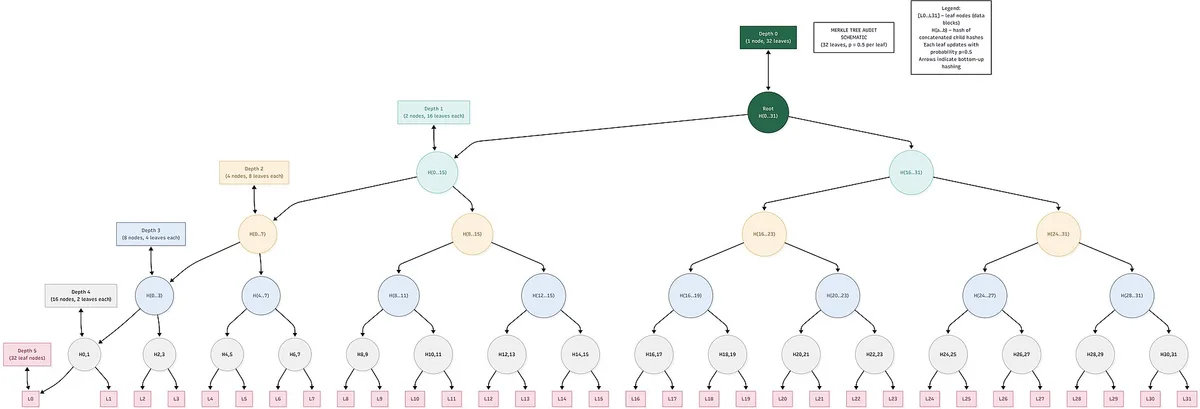
Merkle Trees and How Blocks Verify Their Contents
A Merkle tree turns thousands of transactions into one short root hash. Here is how blocks use it to prove their contents, why proofs stay small, and where the structure shows up outside crypto.

A Merkle tree turns thousands of transactions into one short root hash. Here is how blocks use it to prove their contents, why proofs stay small, and where the structure shows up outside crypto.

Smart contracts cannot see prices, weather, or sports scores on their own. Blockchain oracles feed them outside data. Here are the main oracle types and the trust trade-off they bring.

A press-release launch with a big treasury number, an ICO, and casino-style dApps. Here is what is verified, what is only self-reported, and what to check before touching it.

Tracing stolen funds is less a cinematic chase and more patient record-keeping. Here is what the work actually involves, and who bears the risk when it fails.

A distributed ledger is just three moving parts: a chain of records, computers holding copies, and a rule for agreeing on the next one. Here is what each part does, and what it does not guarantee.

Strip away the jargon: a blockchain is a shared record book that thousands of computers keep copies of, and that is what makes it hard to quietly rewrite.

No committee decides what your dollar is worth abroad. Here is the mechanism, and who takes a cut when you convert.

A Korean bank settled a $100 million bond the same day it was issued. Here is how same-day settlement works and what it changes.

A calm audit of the durable ideas behind the buzzword — and the parts that have not earned the marketing fog around them.