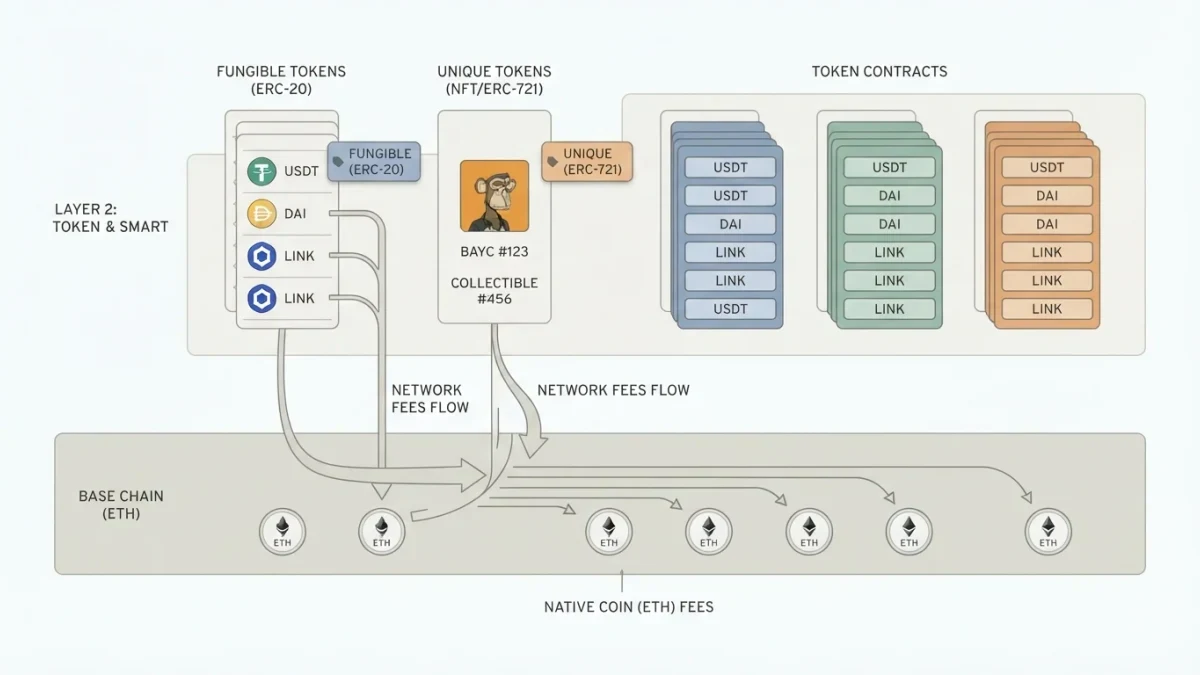
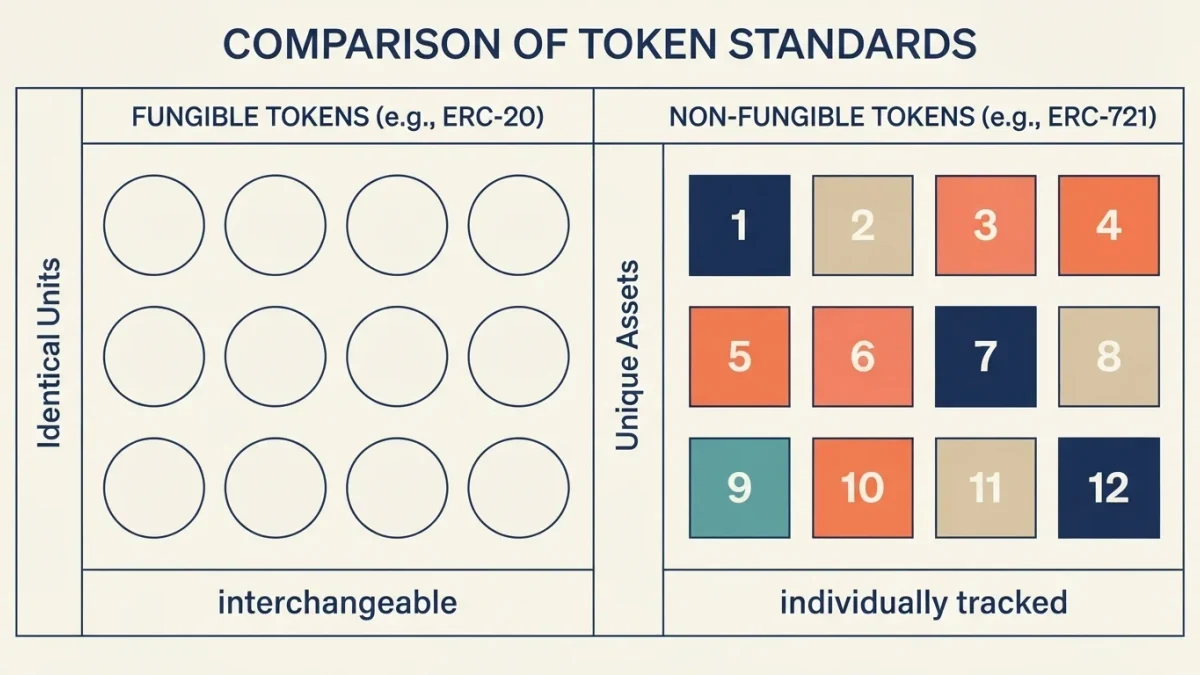
A token standard is a shared set of rules that a token's contract must implement so that wallets, exchanges, and other contracts can handle it without custom work. ERC-20 defines interchangeable tokens — one unit equals any other. ERC-721 defines unique ones — each token tracked individually. Standards are why any Ethereum wallet can hold any Ethereum token.
Crypto assets are volatile and can lose most or all of their value quickly, and nothing in this article is a reason to buy any of them.
What problem does a standard solve?
Coordination. Before standards, every token was bespoke software, and every wallet and exchange needed custom code to support each one — slow, error-prone, and easy to get wrong. A standard is a common interface: implement these functions with these behaviors, and the entire existing ecosystem can use your token the day it launches.
The closest everyday analogy is the USB port: a shared plug shape that let a thousand manufacturers build devices without coordinating one-to-one. Flag it as an analogy — the precise version is a behavioral contract. A token standard does not say what a token is for; it says which functions the contract must expose and how they must respond, so that software written years earlier can interact with a token deployed this morning.
That is also why standards became the load-bearing layer of the token economy. "It follows ERC-20" is a one-line integration instruction. Wallets list the token, exchanges custody it, other contracts swap it — no meetings required. Standardization converted compatibility from an expense into a default.
What does ERC-20 define?
ERC-20, proposed in November 2015, defines fungible tokens: every unit identical, balances kept as plain numbers. The contract must expose a known vocabulary — transfer, balance check, allowance — so any wallet, exchange, or dApp can move and display tokens it has never seen. It is the most implemented token format on Ethereum.
Fungibility is the key word. Think of shares in one company's stock — an analogy, and the precise version follows: the contract keeps a ledger of address-to-number. There are no individual units to tell apart, because "which one" is not a meaningful question. One token from your balance spends exactly like another.
The required vocabulary is small — a handful of functions covering transfers, balance queries, and approvals. The approval functions deserve special respect: they are the mechanism by which you let another contract spend your tokens, the same allowance that dApps request and that malicious contracts abuse. The standard created the plug; caution remains the user's job.
Practically everything with a ticker that runs on Ethereum is ERC-20: stablecoins, governance tokens, reward points, and the long tail of speculative issues. They differ wildly in honesty and value while sharing one interface — a fact the final section returns to.
What does ERC-721 define?
ERC-721, finalized in 2018, defines non-fungible tokens: each has a distinct ID, a separate owner, and its own history. The contract tracks every token individually — who owns #47, who owned it before. The immediate ancestor was CryptoKitties, the December 2017 game whose one-of-a-kind cats didn't fit ERC-20.
That origin story is the standards process working as designed. CryptoKitties launched with custom contracts that behaved like collectibles: each cat unique, individually owned. The pattern was common enough to be worth standardizing, and ERC-721 — published in 2018 by its four authors — turned the practice into a shared format. The cats preceded the standard; the standard wrote down what the cats were doing.
The structural difference is in the accounting. An ERC-721 contract answers "who owns this specific token," not "how much does this address hold." That is why an NFT collection can show you the provenance of one item, and why your wallet displays tokens from the two standards differently — numbered items on one shelf, quantities in one tank.
Is one standard better than the other?
Neither is an upgrade of the other — they solve different problems. When units should be interchangeable, ERC-20 fits: money, votes, reward points. When each unit must be individually identified, ERC-721 fits: tickets with seats, collectibles, deeds. Choosing is a design decision about what the token must represent.
Fungibility is a function, not a ranking:
| If the token should be… | Use | Everyday examples |
|---|---|---|
| Interchangeable — any unit as good as any other | ERC-20 | Stablecoins, governance votes, loyalty points |
| Individually identified — unit 47 is not unit 48 | ERC-721 | Seated tickets, collectibles, ENS names |
| Semi-unique — limited editions with several copies each | ERC-1155 (a later hybrid) | Game items issued in batches |
The hybrid row is worth knowing exists: later standards blended the two models for cases like game inventories, where a sword might have fifty identical copies and a trophy exactly one. For most purposes, though, the load-bearing pair remains ERC-20 and ERC-721 — the split between currency accounting and object accounting. If the vocabulary in this paragraph is new, a BBC News glossary of crypto terms collects short definitions of most of it.
What does a standard not guarantee?
Nothing about quality, safety, or value. A standard guarantees shape, not substance: a well-formed scam token passes every compatibility check, and a perfectly honest token can still crash to zero. Standards also enable the allowance mechanism that malicious dApps abuse. Compliance is plumbing, not endorsement.
Scam tokens exploit exactly this gap. Sending someone a fake token that imitates a famous name costs almost nothing, and the token will display in wallets flawlessly — because wallets only check the interface, not the intent. The defense is mechanical: identify a token by its contract address from the project's own official channel, never by its displayed ticker, which anyone can set to anything.
The same humility applies to token promises. "Fixed supply, ten million tokens" is a claim about code; whether it is true depends on what the contract actually says, and on whether the deployer kept any upgrade keys. A standard makes a token legible to software. Reading what it says remains a human task.
So the takeaway: standards solved the compatibility problem — any wallet, any token, no custom integration — and in doing so they made the ecosystem composable at a scale traditional finance never reached. What they standardized was the container. What anyone puts in it, and what that is worth, was never the standard's business.