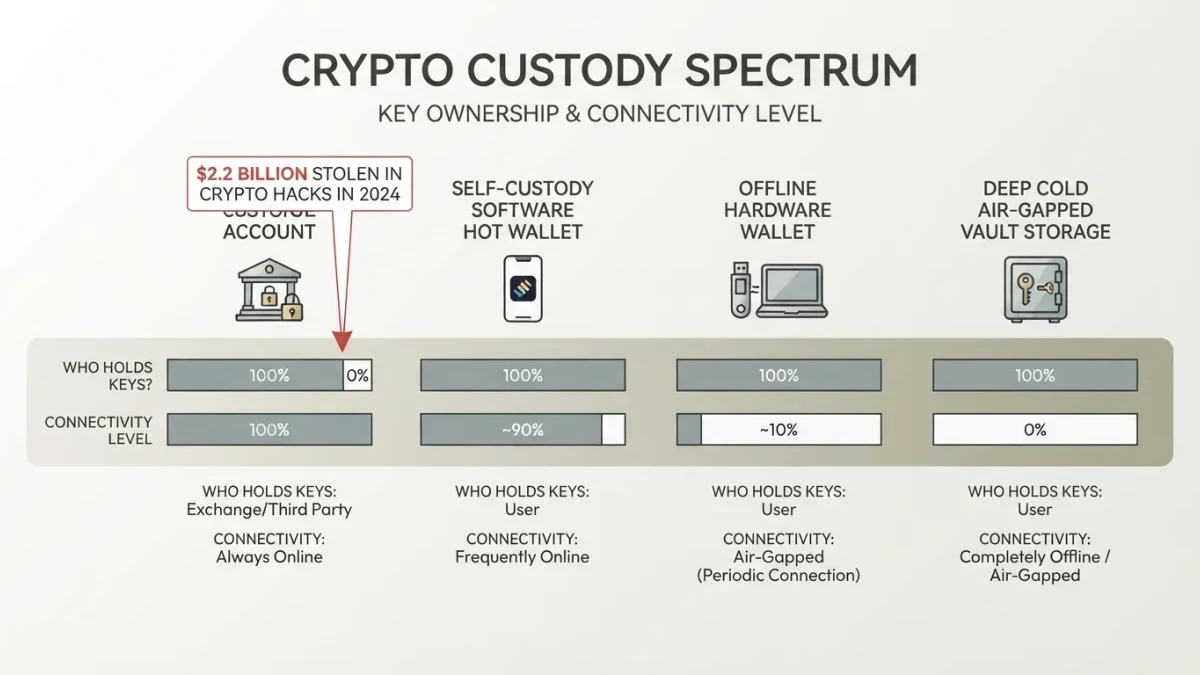

A custodial wallet is an account where a company holds your private keys for you; a self-custody wallet is one where you hold them yourself. That single difference decides who can recover the account, who can freeze it, and who is to blame when something goes wrong. Neither option is safe by default — they distribute risk differently.
Crypto assets are volatile and can lose most or all of their value quickly, and nothing in this article is a reason to buy any of them.
What does "custody" mean for a wallet?
Custody means holding the private key — the secret code that controls a wallet's funds. A blockchain does not know your name; it only knows signatures. Whoever can sign, moves the coins. So "who has custody" reduces to one question: who can produce the key the network will accept?
A helpful analogy is a safe deposit box: the bank guards the vault, but you hold a key. The analogy breaks down immediately, because a crypto key can be copied perfectly and a vault key cannot — and because a blockchain has no vault to drill open or court order to obey. The precise version: funds on a blockchain are controlled by a secret number, and custody is simply the question of who controls that number.
Everything in this comparison follows from that. Recovery, freezing, hacking, bankruptcy, responsibility — all of them are downstream of where the key sits.
How does a custodial wallet work?
You open an account, complete identity checks, and the company holds the keys behind the scenes. Sending crypto feels like using a banking app: balances on a screen, password resets, support tickets. The trade is simple — you gave up key control for convenience, and your balance is now the company's liability to you.
Technically, most exchanges pool customer funds under their own keys — your "wallet" is a row in their database. That is what makes instant password resets and customer support possible. It is also what makes the model fragile in specific ways: the company can be hacked at the level where everyone's funds actually live, it can freeze or restrict withdrawals, and in some countries it can be compelled to do so by authorities.
The failure mode is counterparty risk — the risk that the party holding your keys fails you. It is not hypothetical. Exchanges have been hacked repeatedly since the industry's earliest days, and the largest collapse of all arrived in November 2022, covered below.
How does a self-custody wallet work?
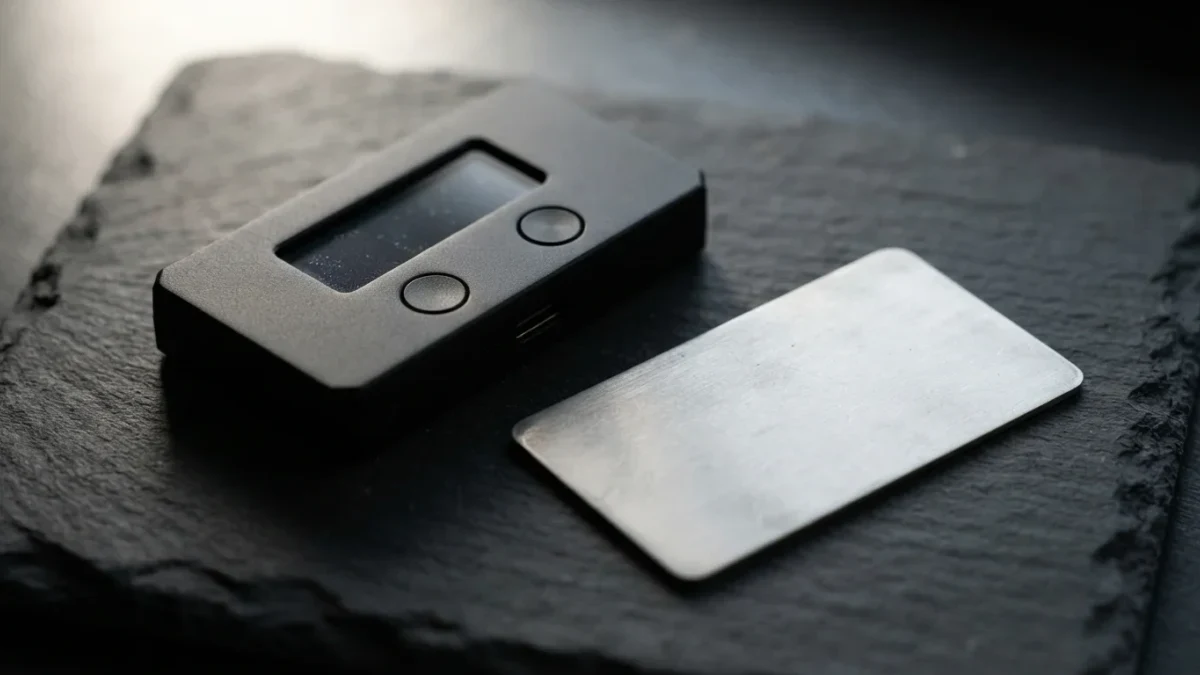
The wallet generates your keys and shows a seed phrase — typically twelve or twenty-four words that can rebuild everything. You store those words offline; anyone who gets them gets the funds. There is no reset, no support desk, and no recovery if the phrase is lost. Convenience is gone; key control is total.
What the wallet actually holds is the keys, not the coins — the coins never leave the blockchain. When you send a transaction, your wallet signs it with your private key and the network verifies the signature. No company sits in that path. Nobody can freeze the address; nobody can restore it either.
Now the sentence that gets skipped too often: self-custody is not safe by default. It replaces company risk with personal risk. The seed phrase must survive fire, flood, moves, your own mistakes, and every scammer who ever convinces anyone to type twelve words into a website — and it must do so for as long as you hold the assets. Self-custody done carelessly is not freedom; it is an unattended safe with the combination written on the door.
Phishing is the active threat. Modern scams do not crack keys — they request signatures and approvals, and a wallet obeys exactly what you confirm. The security perimeter in self-custody is your attention, at every prompt, forever.
Which risks sit on which side?
They fail in opposite directions. A custodial wallet fails when the company does — a hack, a freeze, a bankruptcy — and an unsecured claim is what remains. A self-custody wallet fails when you do: a lost phrase, a phishing signature, a wrong address. Neither failure is rare; the table below puts the split in one place.
| Question | Custodial wallet | Self-custody wallet |
|---|---|---|
| Who holds the keys? | The company (exchange or app) | You, and only you |
| Lost your login or seed phrase? | Password reset and identity checks restore access | Nothing to reset; funds are unreachable without the phrase |
| Who do you call for help? | Customer support, with response times and limits | No one; documentation and community guides |
| Main ways funds get lost | Platform hack, insider fraud, frozen withdrawals, bankruptcy | Lost or stolen seed phrase, phishing approvals, wrong-address sends |
| Your own mistake | Often recoverable through support | Usually permanent, immediately |
| Company failure | Access halts; you become a creditor in a legal process | Irrelevant; keys keep working regardless |
| Legal and insurance protections | Varies by jurisdiction and platform; rarely covers every loss | Effectively none; possession is the entire system |
| Everyday experience | Familiar app-store software, password, 2FA | Seed phrase management, signing prompts, transaction fees |
Read the table as a menu of failure modes, not a scoreboard. A custodial account with strong security and a solvent operator may serve someone well for years; a self-custody wallet with careful backups may never lose a cent. Both statements have exceptions, and the exceptions are the point.
What actually happened at FTX?
In November 2022, FTX — then one of the largest crypto exchanges — filed for U.S. bankruptcy after customer withdrawals exposed a multi-billion-dollar hole, per Reuters. Customers' access froze; many became creditors in a bankruptcy process. It is the canonical lesson in counterparty risk: the app worked fine until the company behind it didn't.
The detail worth remembering is that nothing about the blockchain failed. The filing on November 11, 2022, and the founder's exit the same day, stranded customer balances that had been under the exchange's custody — keys the company held, for assets customers could no longer reach. Bitcoin and Ethereum processed every transaction that week exactly as designed.
The honest ledger has two columns, though. FTX-style collapses argue against trusting companies. But the quiet, unrecorded column — seed phrases lost in moves, drained by phishing, typed into fake sites — never makes the news, because there is no company to sue and no headline to write. Both models lose people money; they just fail in different silences.
So the practical reading: the choice is not "safe versus risky." It is choosing which risks you are equipped to carry — institutional failure on one side, personal operational discipline on the other. Anyone who describes either option as simply safe is selling the simpler story, not the accurate one.