
A blockchain is a shared digital ledger — a record book that many computers keep identical copies of at the same time. New records are bundled into blocks, and each block is stamped with a cryptographic fingerprint of the one before it. That link is what makes past records hard to change without everyone noticing.
The important qualification: "hard to change" is not the same as "impossible." Chains can be rewritten if enough of the network agrees, and forks — competing versions of the ledger — are a real, documented possibility. What a blockchain actually gives you is a record where any change has to be visible to, and accepted by, most of the network. That is the whole trick, and everything else follows from it.
Think of it like a shared notebook that a thousand people photocopy after every page is added. If someone alters one copy, it no longer matches the other 999. The analogy breaks down here: a real blockchain also uses cryptography to bind each page to the previous one, so tampering with an old page would break the fingerprints of every page after it — and the network would reject your copy as the fake one.
What does a block actually contain?
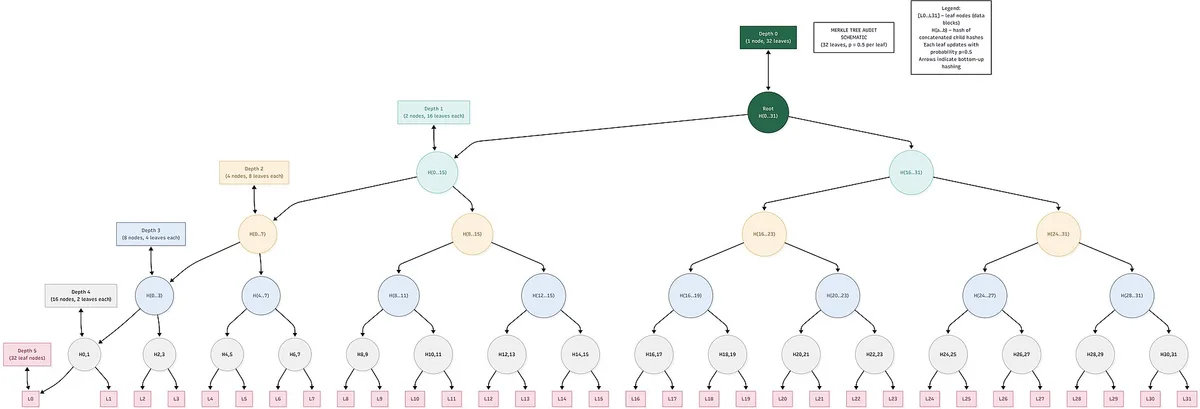
Each block carries three things, as Wikipedia's overview of blockchain describes it: a cryptographic hash of the previous block, a timestamp, and the transaction data itself, usually organised in a structure called a Merkle tree. The hash is the key part. A hash is a fixed-length fingerprint produced from a block's contents — change one character in the data and the fingerprint changes completely.
So block 500 contains the fingerprint of block 499, which contains the fingerprint of block 498, and so on back to the first block. That is the chain in blockchain. To quietly alter an old transaction, you would have to redo that block and every block after it, then convince the rest of the network to accept your version. On a large public network, that is effectively out of reach — not by magic, but by arithmetic and economics.
For a closer look at the contents, see our guide to what goes inside a blockchain block.
Who keeps the ledger honest?
No company owns a public blockchain's ledger. It is maintained by a peer-to-peer network of computers called nodes, each holding its own copy and following the same rulebook. As IBM explains in its blockchain primer, transactions are validated through a consensus mechanism — a process the network uses to agree on which new block is legitimate — so the participants reach agreement without a central referee.
That rulebook is the consensus mechanism, and it matters more than the marketing. Different chains use different methods to decide who may add the next block and how disagreements are settled. If you want the mechanics, our explainer on what a consensus mechanism is covers the main designs. The honest caveat: consensus rules can fail or be attacked. A party controlling most of the network's processing power could in principle rewrite recent history, which is the threat behind a 51% attack.
Why did someone build this in the first place?
The trigger was a problem that had blocked digital cash for decades: double-spending. A digital file copies perfectly, so what stops someone spending the same coin twice? Traditional systems solve it with a bank keeping the master ledger. Blockchain solves it differently — the shared ledger confirms that each unit of value was transferred only once, without needing a trusted authority or central server. For related coverage, see What T+0 settlement means, and why Hana Bank's digital bond matters.
The design arrived in 2008, published under the pseudonym Satoshi Nakamoto, and was implemented in 2009 as the ledger behind bitcoin. It built on earlier work — cryptographer David Chaum proposed a blockchain-like protocol in 1982, and Stuart Haber and W. Scott Stornetta described a cryptographically secured chain of blocks in 1991, aiming to make document timestamps tamper-proof. Nakamoto's contribution was a way to timestamp blocks without any trusted party signing them.
What a blockchain does well — and what it doesn't
Our analysis: the genuine strengths are narrow and worth stating precisely. Records on a shared ledger are visible to participants, hard for any single party to quietly revise, and carry their own audit trail. IBM lists traceability, tamper-evident records and reduced reconciliation work as the main business benefits. If a transaction contains an error, it is not deleted — a correcting transaction is added, and both stay visible.
The limits are just as real. A blockchain is a slow, expensive kind of database compared with a normal one, because every participant does the work of checking and storing everything. "Immutable" records are only as permanent as the network's consensus — a contested fork can split history. And a ledger is only as trustworthy as what gets written into it: a blockchain faithfully records false data just as permanently as true data. Anyone selling a private, permissioned version of the technology should be asked what security model actually protects it; Wikipedia notes that Computerworld once called the marketing of such systems without one "snake oil," though others argue carefully designed permissioned chains can work in practice.
For the trade-offs between open and closed designs, see public vs private blockchains, explained.
How does this connect to crypto and Web3?
Cryptocurrencies were the first mass use: the blockchain is the ledger that records who owns what, so balances can be checked by anyone running a blockchain node. Later, platforms such as Ethereum extended the idea from recording transactions to running programs on the chain — smart contracts, which execute automatically when their written conditions are met. Our guide to how smart contracts actually work walks through that.
From there the field widened into what people now call Web3 — decentralised finance, tokens, and applications that lean on these shared ledgers instead of company databases. The scale has grown with it: Wikipedia records that the bitcoin blockchain's data file passed 600 GB by 2024, up from about 20 GB in 2014. That growth is the ordinary cost of a ledger everyone copies in full.
What this means: the one-minute version
If a friend asks, here is the honest one-minute answer. A blockchain is a record book copied across thousands of computers. New entries are grouped into blocks, and each block carries a fingerprint of the previous one, so the whole history locks together. No single company controls it; the network follows shared rules to agree on each new block. Changing an old entry would mean redoing the chain and winning the network's agreement — practically impossible on a big public chain. It solves one specific problem, keeping a shared record without a referee, and it does so at real cost in speed and storage. It is not a guarantee of truth, not a risk-free technology, and not — on its own — a reason to buy anything.
For more on how distributed ledgers reach agreement and what guarantees they do not provide, browse our blockchain section.