
Before any crypto trade, ask the uncomfortable question: is the price on my screen the price I will actually pay? Often it is not. Slippage is the difference between the price you expect when you place an order and the price you actually get when it fills. It is not a fee anyone charges you, and it can cut your results on every trade, especially in small or fast-moving markets.
A liquidity is how easily an asset can be bought or sold without moving its price. Thin markets slip. According to SoFi's explainer on crypto slippage, slippage is the difference between the expected price and the executed price, driven by volatility and low liquidity, and it happens in stock, bond and foreign-exchange markets too — crypto is just more prone to it because trading never stops and liquidity is spread thin across thousands of pairs.
This piece explains where slippage comes from, why it varies by market and by venue design, and what you can realistically do about it. None of this is a reason to trade or to buy anything. Crypto assets can lose most or all of their value quickly, and slippage is only one of several costs stacked against you.
What exactly is slippage in crypto?
Slippage is the gap between your expected price and your executed price. Say you place a market order — an instruction to trade right now at whatever the current price is. Between the moment you click and the moment the trade settles, the price can move. If you meant to buy at one number and filled at a slightly worse one, that gap is negative slippage. If the price moved in your favour, that is positive slippage.
As Coinbase's glossary entry puts it, slippage can be positive or negative, and it is primarily caused by market volatility and low liquidity. The key point: it is a market outcome, not a charge. Nobody bills you for it, which is exactly why it is easy to overlook.
One related idea deserves its own definition: price impact. A very large order consumes the best available offers first, then the next best, and so on, walking the price against itself. Price impact is the part of slippage caused by your own order size rather than by the market moving while you waited.
Why does slippage happen? Four causes
Four factors drive most slippage, and they compound:
- Low liquidity. In a thin market there may not be enough orders at your price to fill you. The order fills at progressively worse prices. Small tokens are the usual victims.
- Volatility. Crypto prices can move sharply within seconds. The faster the market moves, the more the price can slip between placing and filling an order.
- Large order size. Even a liquid market will move if your order is big relative to what is sitting at the current price.
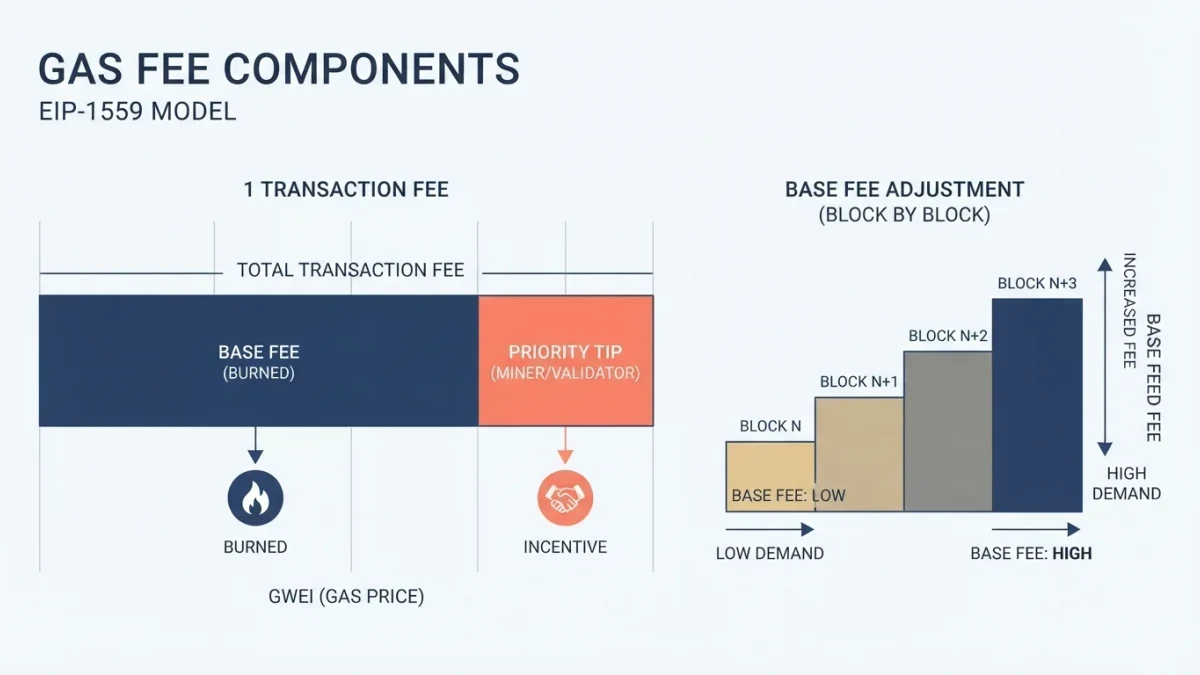
- Network delays. On decentralised exchanges, a swap is a blockchain transaction. If the network is congested, your transaction can wait before it is confirmed — and the price can move while it waits.
That last cause is unique to decentralised trading. On a dApp, your swap runs through a smart contract on-chain, so execution speed depends partly on network conditions rather than on an exchange's matching engine. Congestion and waiting time add a layer of slippage risk that centralised venues largely avoid.
Why slippage varies by venue: order books vs. pools
Where you trade changes how slippage behaves. Centralised exchanges match buyers and sellers in an order book. Slippage there depends on how deep that book is at the moment your order arrives. Deep books in major pairs mean small gaps; thin books in obscure tokens can mean large ones.
Decentralised exchanges work differently. Many use liquidity pools rather than order books: traders swap against a pool of tokens supplied by other users, and the pool's formula sets the price based on the ratio of tokens in it. A big swap shifts that ratio sharply, so price impact is baked into the design. Pools for popular pairs can be deep; pools for small tokens often are not. As Altrady's guide notes, smaller altcoins with thin order books can see slippage of several percent on a single trade, and decentralised venues often carry lower liquidity than centralised ones, which can push slippage higher.
Network fees are a separate cost, but they interact with slippage. High gas fees and congestion tend to arrive together, and congestion is one of the four slippage drivers. Cheaper execution layers, such as the rollups covered in our explainer on how Ethereum rollups make transactions cheaper, can shorten the waiting window in which prices slip — though they do not remove the risk. For related coverage, see How do Ethereum rollups work, and why do they make transactions cheaper?.
What this means: practical ways to limit slippage
You cannot eliminate slippage. You can make it smaller and more predictable. The levers below are general considerations drawn from the sources cited here, not instructions tailored to your situation:
- Use limit orders where possible. A limit order names the worst price you will accept. If the market slips past it, the order simply does not fill. That converts unbounded slippage into a hard ceiling, at the cost of possibly missing the trade.
- Set a slippage tolerance on swaps. Most platforms let you cap the slippage you will accept; if the fill would exceed it, the trade fails. SoFi's guide describes a typical range of roughly 0.25% to 1% for this setting. Set it too wide and you accept bad fills; too tight and trades fail constantly in volatile conditions.
- Trade deeper markets. Major pairs on high-volume venues generally slip less than small tokens on quiet ones.
- Avoid chaotic moments. Sharp news-driven moves and network congestion are when slippage is worst. Patience is a cost-control tool.
- Size orders sensibly. Very large orders relative to available liquidity move the price against you. Splitting a large trade is a common consideration, though each split may carry its own fees.
Our analysis: the most underrated habit is simply looking at the quoted minimum received before confirming a swap. Most decentralised interfaces show it. If that number is far below what the spot price implies, the market is telling you the fill will be poor.
The limits: what slippage controls cannot fix
Every control above has a cost. Limit orders may never fill, so you trade certainty of execution for certainty of price. Tight slippage tolerances cause failed transactions, which on some networks still cost fees. Waiting for calm markets means accepting whatever price exists when calm returns. And positive slippage is not something to rely on — over many trades, unfavourable fills tend to dominate, because faster and better-resourced traders capture the good prices first.
Slippage also sits alongside other costs: trading fees, network fees, and the spread between buy and sell prices. Controlling one while ignoring the others improves little. For a wider view of how decentralised trading fits together, see our guide to DeFi basics: lending and trading without banks.
What the evidence establishes is modest and worth stating plainly: slippage is a structural cost of trading, largest in thin and fast markets, partly manageable with order types and tolerance settings, and never fully avoidable. What remains unknown for any specific trade is the size of the gap — which is why checking the quoted minimum received, every time, is the one step worth making automatic.