
DeFi — decentralized finance — is an umbrella term for financial services built on public blockchains, where smart contracts do the jobs banks and brokers used to do: lending, borrowing, trading, earning interest. There is no branch and no manager; there is code, running around the clock. The services are real, and so are the risks.
Crypto assets are volatile and can lose most or all of their value quickly, yields are never safe, and nothing here is a reason to put money into anything.
What does DeFi replace, exactly?
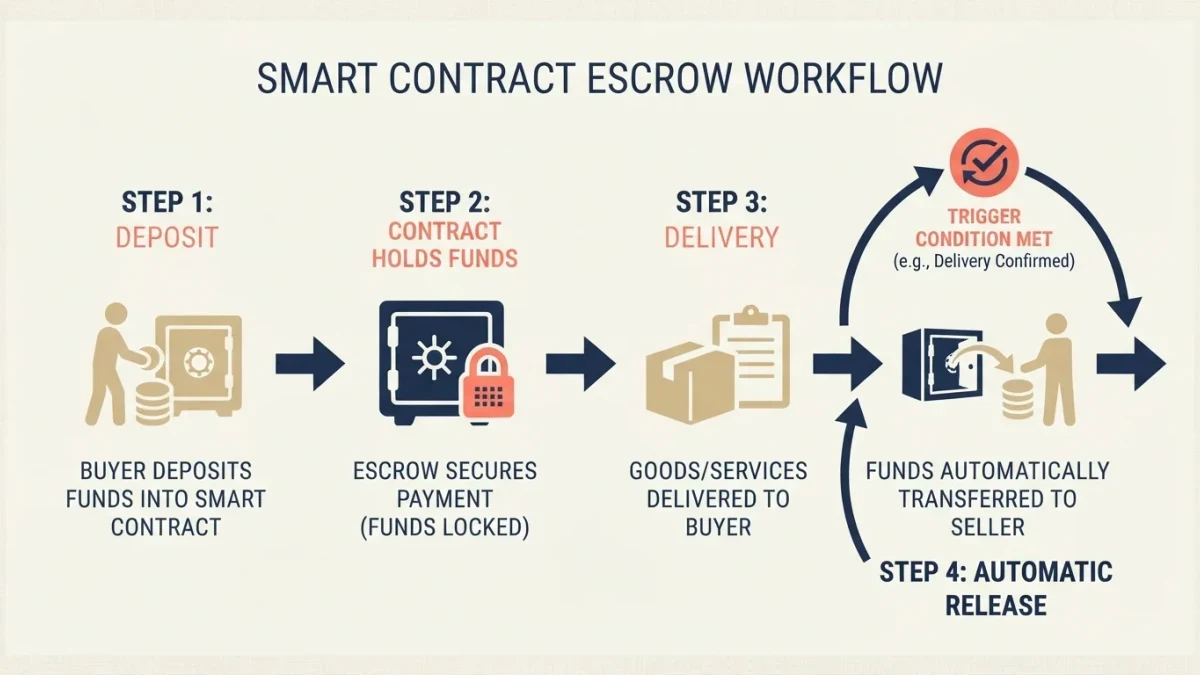
The middlemen: custody, escrow, matching, clearing. A lending protocol holds deposits and issues loans by code; an automated market maker pairs traders with a pool instead of a counterparty. What it does not replace is risk — it relocates risk from the bank's balance sheet to the smart contract and to you.
The mental shift: a bank is a set of promises backed by a balance sheet, regulators, and deposit insurance. A DeFi protocol is a set of functions backed by code and the assets locked inside it. When everything works, the code version is faster, more transparent, and open to anyone. When something breaks, there is no support line, no deposit insurance, and often no recourse.
The transparency is genuine and worth saying twice: the contracts are public, the reserves are public, and anyone can audit the books in real time. That is a level of visibility traditional finance has never offered. It does not cancel the risk; it lets you see the machine before you reach into it.
How does DeFi lending work?
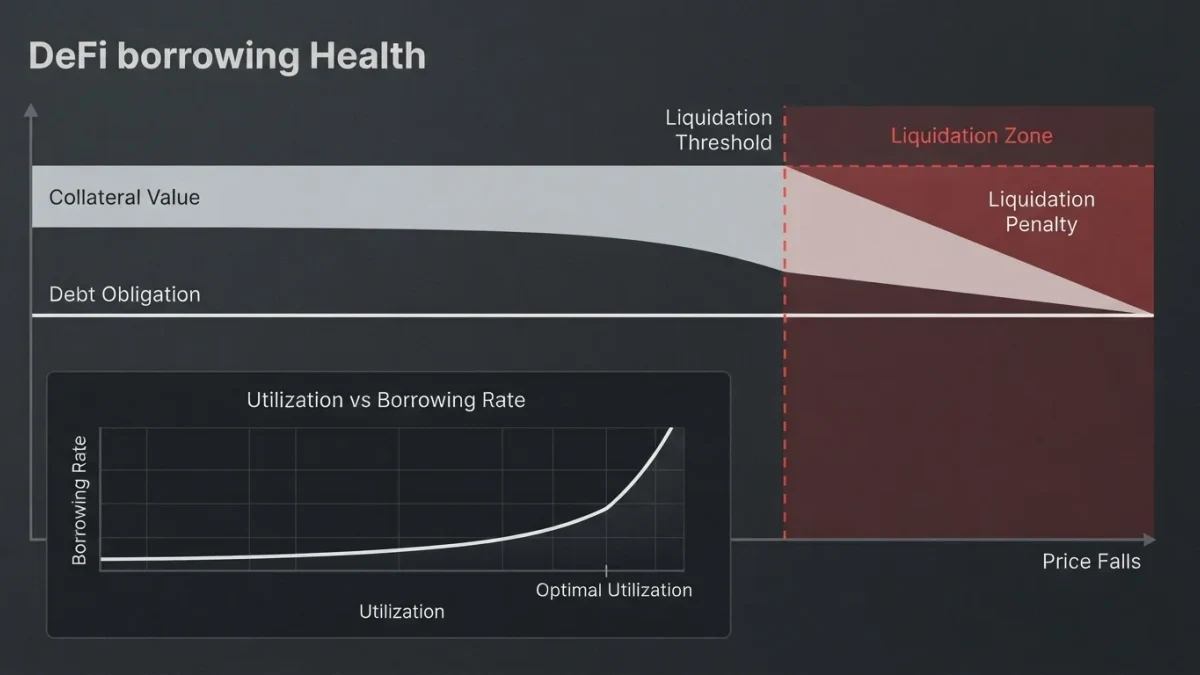
You deposit crypto as collateral and borrow against it — and because there is no credit check, loans are overcollateralized: leave $150 to borrow $100, commonly. Interest rates are set by formula, moving with supply and demand in the pool. If your collateral's value falls too far, the contract liquidates it automatically.
The overcollateralization is the whole trick. A bank trusts your signature and your credit history; a protocol trusts only margin. Crypto prices swing hard, so protocols demand a buffer — commonly 125 to 150 percent or more — and when the buffer thins, liquidation follows.
Liquidation is not a penalty box; it is the mechanism that keeps lenders whole. When your collateral ratio crosses the line, anyone can trigger a sale of part of your collateral, usually at a discount, and your debt is covered. You keep whatever remains, plus whatever you borrowed. In a fast crash, the sale can happen before you have time to react — that is the design working, not failing.
Depositors sit on the other side of the same pool: your "deposit" is a loan to strangers against their collateral, and your interest comes from what they pay. The rate is algorithmic, so it moves — sometimes within hours. A rate quoted today is weather, not climate.
How does trading without an order book work?
Most DeFi trading has no order book and no broker. Instead, traders swap against a pool of two assets funded by users — liquidity providers — and a formula sets the price as the pool's balance shifts. Every trade pays a fee, and those fees flow to the providers. The market maker is a formula, running 24/7.
These are automated market makers, the model Uniswap popularized after its 2018 launch. The pricing formula's job is to keep the pool balanced: buy a lot of one asset from it, and that asset's price inside the pool rises until the pool rebalances. An analogy is a vending machine that reprices its own stock — the analogy breaks down because a vending machine's operator sets the price, while a pool's price is pure arithmetic.
Providing liquidity is its own risk position, not passive income. The pool's composition shifts with trading, and providers can end up holding more of the asset that fell — "impermanent loss," which becomes permanent once you withdraw. Plus the baseline risks: the pool is a smart contract, and the pool's tokens are only as stable as the assets inside them.
Where does the yield actually come from?
Three places, all mundane: borrowers paying interest on loans; trading fees paid by swappers; and token rewards protocols print to attract users. That is the whole menu. Each source can shrink or vanish — borrowers leave when rates flip, volumes dry up, emissions end — so any fixed, high, steady yield deserves suspicion, not savings.
Say it plainly, because the marketing rarely does: yield in DeFi is never safe. It is compensation for bearing risk — contract risk, market risk, and sometimes the risk that the yield itself is bait. Rates that look like a free lunch are usually a loan to something fragile, an emission schedule winding down, or a mechanism nobody has stress-tested.
The honest comparison is not "bank interest versus DeFi interest." It is "deposit insurance and depositors' rights, backed by a regulated balance sheet" versus "an unaudited-by-you contract holding volatile assets, with your position liquidated by formula." Both pay a rate. They are not the same product.
What are the big risks?
Four big ones. Smart-contract exploits drained over a billion dollars from DeFi protocols across 2021–2022. Liquidations turn market drops into forced sales. Stablecoins can lose their peg — Terra's collapse in May 2022 erased tens of billions. And regulators are still catching up; the SEC's $100 million BlockFi settlement came in February 2022.
Contract exploits are the sector's chronic condition. A bug in a lending pool or a bridge is a drain with no valve; Reuters was reporting on DeFi's risks while its boom was still building, in May 2021, and the following year proved the point repeatedly. Audits help and are not guarantees.
Regulation arrived early for the products closest to securities. In February 2022, the SEC announced that the lending platform BlockFi would pay $100 million in penalties — $50 million federal, $50 million to states — for offering an interest-bearing crypto lending product without registering it. The lesson generalizes: "it runs on a blockchain" does not exempt a financial product from financial law.
And the risks stack. DeFi protocols are built on top of one another — a lending platform using a stablecoin using a collateral asset — so a failure at the bottom propagates upward. Composability, the sector's strength, is also its domino arrangement.
So the basics, stated fairly: DeFi is a working parallel financial system — transparent, fast, always open, and unforgiving. It replaces institutional safeguards with personal diligence. Anyone who tells you the first half without the second half is selling something.