Blockchain technology is a shared digital ledger: a growing list of records called blocks, each one linked to the last with a cryptographic hash, kept in sync across many computers. No single operator owns it. The trade-off is that agreement among those computers, not any authority, is what makes a record final — and that agreement is slow and contested by design.
According to Wikipedia, a blockchain is a distributed ledger whose blocks each contain a hash of the previous block, a timestamp, and transaction data, so changing an old record means changing every block after it and getting the network to accept the change. That is the whole trick. Everything else — coins, tokens, smart contracts — sits on top of it.
This piece walks through the three moving parts: what a block actually holds, what the computers running the network do, and how they agree. If you want the plainest possible starting point first, our What is blockchain, really? A plain-English explainer covers the ground in fewer words.
What is a block, and what goes inside one?
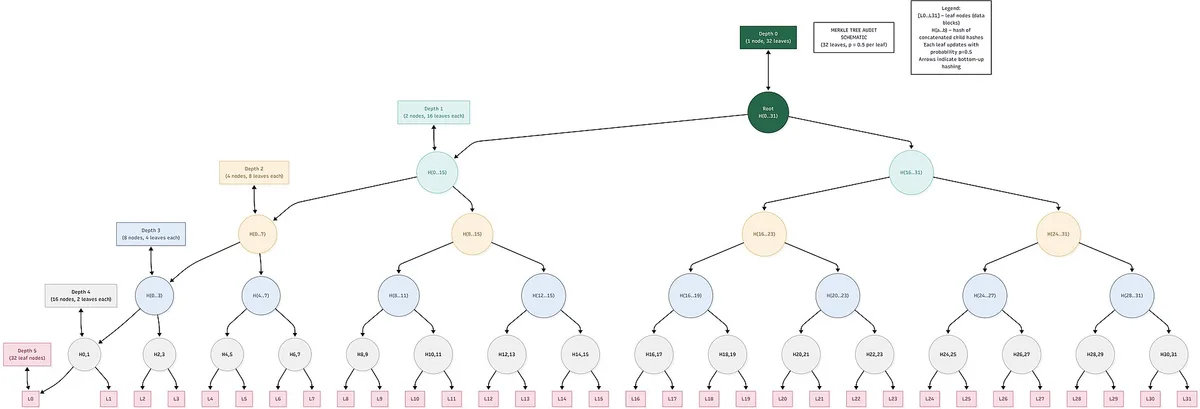
A block is a batch of confirmed records. Per Wikipedia, each block carries three things: a cryptographic hash of the previous block, a timestamp, and the transaction data itself, which is usually organised as a Merkle tree — a structure that lets anyone verify a single transaction is in the block without downloading all of it.
The hash is the part that makes the chain a chain. A hash is a fixed-length fingerprint of data; change one character in the input and the fingerprint changes completely. Because each block stores the previous block's fingerprint, rewriting an old block breaks every fingerprint downstream. The network would reject the tampered version unless it accepted the whole rewritten history, which brings us to consensus.
One caution on the word you will see everywhere: "immutable". The IBM explainer describes records as immutable, but also notes the honest caveat — if an error is recorded, it is not deleted. A new transaction is added to reverse it, and both stay visible. Blocks are extremely hard to change retroactively, not literally impossible. Forks happen, and our hard forks vs soft forks, explained piece covers what happens when the chain splits.
What do nodes actually do?
A node is a computer running the network's software and holding its own copy of the ledger. Nodes pass transactions to each other, check that new transactions follow the rules, and relay valid ones onward. Run enough of them across enough jurisdictions and no single operator can quietly rewrite the shared record.
Two kinds of node matter for a beginner. Full nodes verify everything themselves, from the first block to the latest. Lighter nodes rely on full nodes for some checks and trade trust for convenience. Our What is a blockchain node? explainer goes deeper on the distinction.
Here is what this means in practice: when you send a transaction, you are not asking a company to process it. You are announcing it to a peer-to-peer network, and the nodes decide whether it is valid. Wikipedia traces this design to Satoshi Nakamoto's 2008 bitcoin paper, which solved the double-spending problem — the risk that digital money gets spent twice — without a trusted central server. IBM's overview notes the same lineage and adds that platforms like Ethereum, launched in 2015, extended the ledger to run smart contracts, which are agreements written in code that execute automatically.
What is consensus, and why does it matter?
Consensus is the rule the network uses to agree on the next block. Without a boss, the computers need a procedure for deciding whose version of history counts. Different chains use different procedures — proof of work makes participants spend computing effort to propose blocks; proof of stake makes them post value they lose if they cheat. Our What is a consensus mechanism? piece compares them in detail.
Consensus is also where the guarantees get thinner than marketing suggests. Wikipedia notes that blockchain records are not unalterable — forks are possible — and that a majority of the network's power colluding can rewrite recent history, the scenario behind our What is a 51% attack? explainer. The security comes from making that collusion expensive and visible, not from making it impossible.
Timing matters too. A transaction in the latest block is not instantly irreversible; different chains give different finality guarantees. Our What does block finality mean? explainer covers when a transaction is truly settled.
Public, private, and everything in between
Not every blockchain is open to everyone. The sources describe a spectrum. Public blockchains let anyone read, write, and verify. Private ones restrict access to authorised participants, typically inside companies. Consortium chains are run by a fixed group of organisations, and hybrid designs mix elements of each. Our Public vs private blockchains, explained piece lays out the trade-offs side by side.
The private variants carry a real criticism. Wikipedia records that Computerworld called the marketing of such privatised blockchains, without a proper security model, "snake oil" — a database with extra steps and none of the decentralised guarantees. Others counter that a carefully designed permissioned chain can be more secure in practice. Both positions are worth holding in mind when a company announces a "blockchain solution": the word alone tells you very little about what is actually being guaranteed.
Our analysis: what the machinery does and does not give you
Strip away the vocabulary and blockchain technology does one specific job. It lets a group of mutually distrusting computers maintain one shared record, using hashes to make tampering evident and consensus to make tampering expensive. IBM's overview frames the benefit the same way: security, transparency and a single source of truth without relying on intermediaries such as banks.
What it does not give you is a free lunch on trust. You still trust something — the consensus rules, the code, the economic incentives, and the majority of the network. The ledger removes the administrator who could quietly edit a database. It replaces that administrator with a rule, and rules can have bugs, forks, and majorities that misbehave. That is the honest frame for everything built on top, from coins to contracts.
If you want to see the machinery directly, our How to read a block explorer, step by step guide shows you real blocks, hashes and timestamps in a browser — no wallet needed. And for how the ledger's contents are structured, see What goes inside a blockchain block?
The bottom line for newcomers
The evidence here supports a narrow, useful conclusion. A blockchain is a hash-linked chain of blocks, maintained by peer-to-peer nodes, extended only by consensus. It solves double-spending without a central operator, which is a genuine engineering achievement. It does not make records physically unchangeable, it does not remove all trust, and private versions may not deliver decentralisation at all.
One last caution, since this site covers assets built on this machinery: crypto assets can lose most or all of their value quickly, and nothing here is a reason to buy any of them. Understanding how the ledger works is worth doing for its own sake. It will not tell you what a token is worth — only who bears the risk when the machinery is stressed.