A public blockchain is one that anyone can read, use and help verify — Bitcoin and Ethereum are the familiar examples. A private blockchain restricts those permissions to an approved membership. The public vs private blockchain question is therefore about access: who may submit transactions, see the record, and hold the infrastructure accountable.
Crypto assets can lose most or all of their value quickly, and nothing on this site is a reason to buy any of them. This is a comparison of designs, not of assets.
What makes a blockchain public?
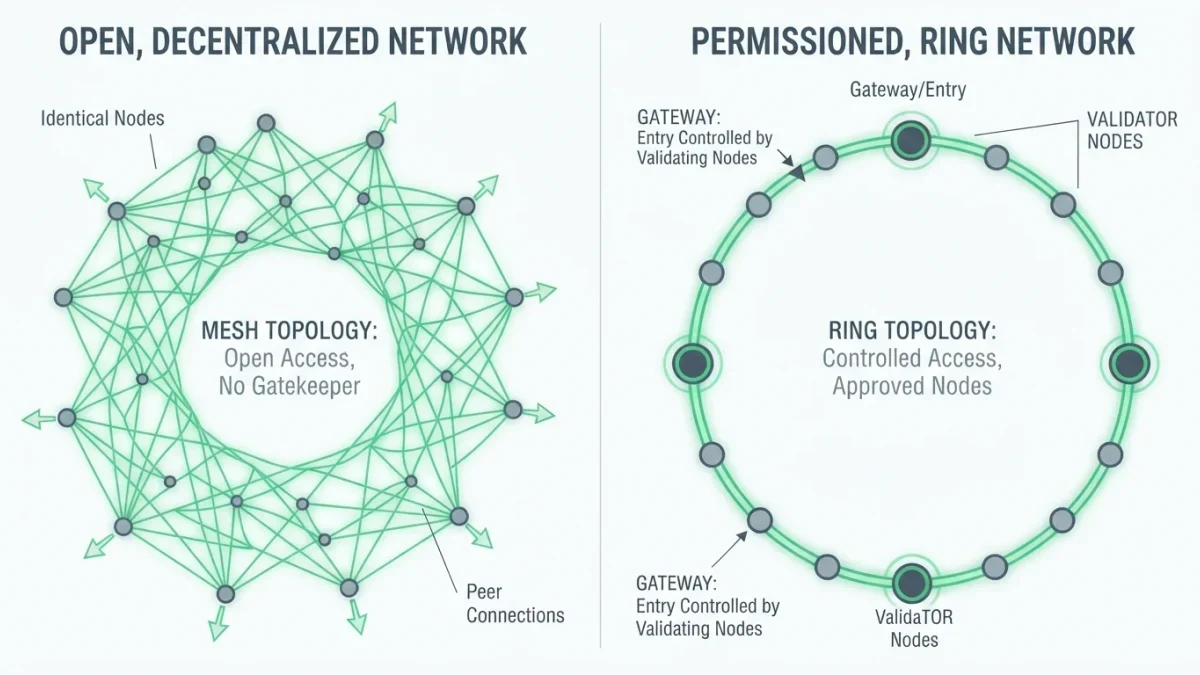
Open doors in every direction. Anyone can download the software, read every transaction, broadcast their own and help verify blocks without asking anyone's permission. Bitcoin, live since 2009, and Ethereum, since 2015, work this way. The trade is radical transparency and censorship resistance in exchange for slow, crowded consensus.
Openness is structural, not a policy toggle. There is no membership list to join, no identity check to pass and no operator who can revoke a stranger's access. The same rules bind the largest exchange and the smallest wallet, and anyone can audit the deepest claims — total supply included — with a laptop and some patience.
The price is performance. Every participant must be able to check everything, which caps how fast a truly open network can move. Public chains accept that ceiling on purpose: what they are buying with it is the absence of a bouncer.
What is a private, or permissioned, blockchain?
A ledger with a membership list. One or several organizations decide who may run nodes, submit transactions and — sometimes — who may read the record at all. Hyperledger Fabric, an open-source framework the Linux Foundation has hosted since 2016, is the best-known toolkit for building this kind of network.
Permission is the operative word. Members are vetted, often legally identified, and the operator can add or remove them — the mirror image of a public chain, where the only way to remove a participant is for everyone else to refuse their blocks. Sometimes even reading is gated, which makes these systems closer to shared corporate infrastructure than to public records.
The engineering bet is that known participants can reach agreement faster than anonymous crowds. Whether the bet pays is contextual, but the mechanism is well established: fewer, identified parties mean less Byzantine overhead — the fault-tolerance problem that public chains solve with brute decentralization.
Who actually uses private blockchains?
Consortiums more than companies alone: groups of banks testing interbank settlement, retailers and logistics firms tracing shipments, insurers sharing claims data. Central banks have studied permissioned designs too — the U.S. Federal Reserve's January 2022 discussion paper on digital currency weighed them carefully — though many corporate pilots wind down quietly.
The corporate history is instructive. Produce-tracking pilots announced by major retailers in 2018 made headlines; trade-finance consortiums assembled banks that compete everywhere else; each promised reconciliation without a central intermediary. Some of that machinery is still running. A good deal of it was quietly retired, and the honest reporting lesson is that pilots launch with press releases and end with silence.
Central-bank interest runs on a separate track. Dozens of monetary authorities have experimented with wholesale settlement on permissioned ledgers, and the Fed's 2022 paper treated openness, privacy and intermediation as design dials to set rather than doctrines to obey — a framing researchers still use.
What do the two designs trade away?
Public chains trade speed and privacy for openness no one can revoke. Private chains trade that openness for control: known participants, faster agreement, confidentiality — and a quiet dependence on whoever administers the membership list. The right question is not which is better, but who needs to trust whom.
| Public blockchain | Private (permissioned) blockchain | |
|---|---|---|
| Who joins | Anyone, without registration | Approved members only |
| Who reads | Everyone | Members, or whoever the operator allows |
| Rule changes | Public process, often slow and contentious | Set by the operator or consortium |
| Strength | Censorship resistance, auditability | Control, confidentiality, throughput |
| Weakness | Slow, transparent by default | Depends on the membership's honesty |
| Examples | Bitcoin (2009), Ethereum (2015) | Enterprise networks on frameworks like Hyperledger Fabric (2016) |
For a reader sorting announcements into buckets, a quick test works: ask who could stop you. If the honest answer is nobody — no admin, no court order served on one company, no membership committee — the network is public. If some operator could switch you off tomorrow, whatever the brochure says, you are looking at a permissioned system in similar clothes.
Is a private blockchain just a slow database?
Sometimes, yes — and engineers say so plainly. When a single operator controls every permission, an ordinary database does the same job faster and cheaper. Distributed ledgers earn their keep when several parties who do not fully trust each other need one shared record, which is exactly the case public chains take to the extreme.
The skeptic's question deserves the skeptic's answer, and the U.S. standards body's 2018 overview gives it: blockchains buy tamper-evident agreement between parties who lack a trusted intermediary, and when such an intermediary already exists — a parent company, a dominant bank — the blockchain premium is often paying for theater.
That is why serious enterprise evaluations start with a trust map: which parties distrust which, and what would each require of a shared record. Public chains answer the maximal version of that question. Private ones answer negotiated, narrower versions — and the honest failure mode is spending blockchain money on a database problem.