Gas fees are the payments users make for a blockchain to process a transaction. On Ethereum, every calculation costs "gas," a unit of computational work, priced in ether. Fees rise and fall because block space is fixed and demand is not: when more people transact than a block can hold, prices get bid up.
Crypto assets are volatile and can lose most or all of their value quickly, and nothing in this article is a reason to buy any of them.
Why do blockchains charge fees at all?
Two reasons: spam control and paying the workers. A blockchain with free writes would be drowned in junk within hours — the fee is a toll that makes flooding the network expensive. And the fees go to the validators or miners who process transactions, which is what pays them to run the network at all.
Every blockchain has a physical budget. Blocks are produced on a schedule — roughly one every twelve seconds on Ethereum since its 2022 move to proof of stake — and each block holds a limited amount of computation. That limit is the scarce good being sold. The fee is not a payment for a product so much as a winning bid in a recurring auction for the next slot.
That framing explains almost everything about fee behavior. Auctions clear at whatever the traffic will bear, so the price is a real-time reading of demand — a congestion indicator you pay for personally.
How is a gas fee actually calculated?
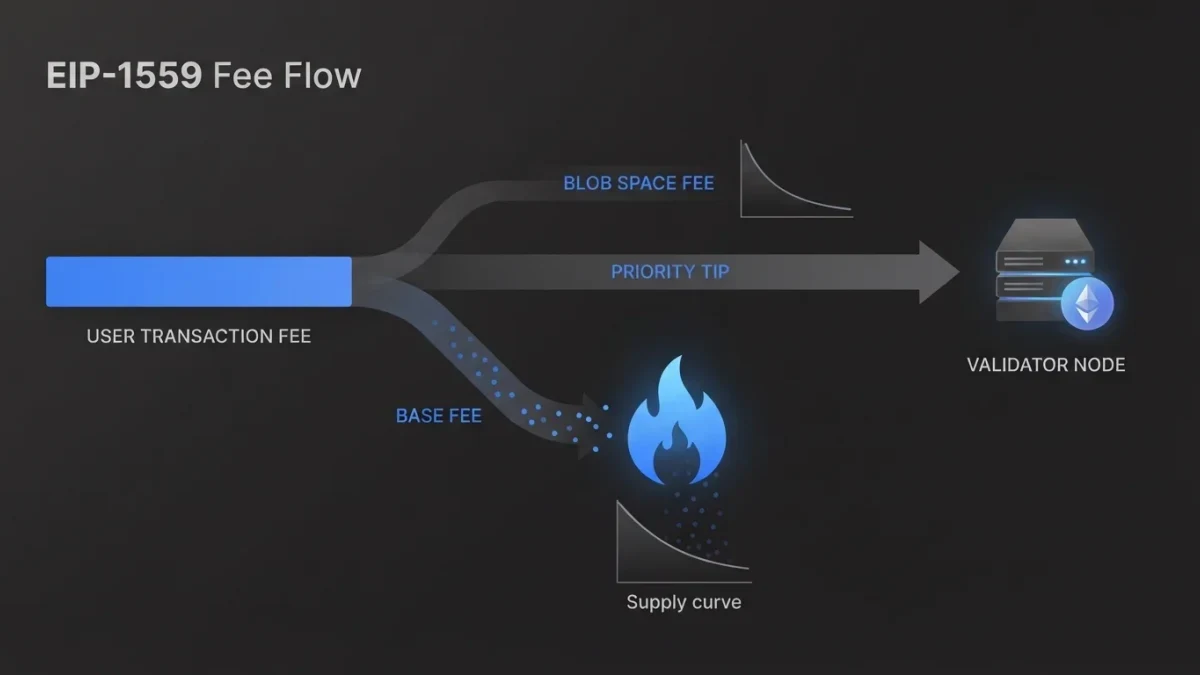
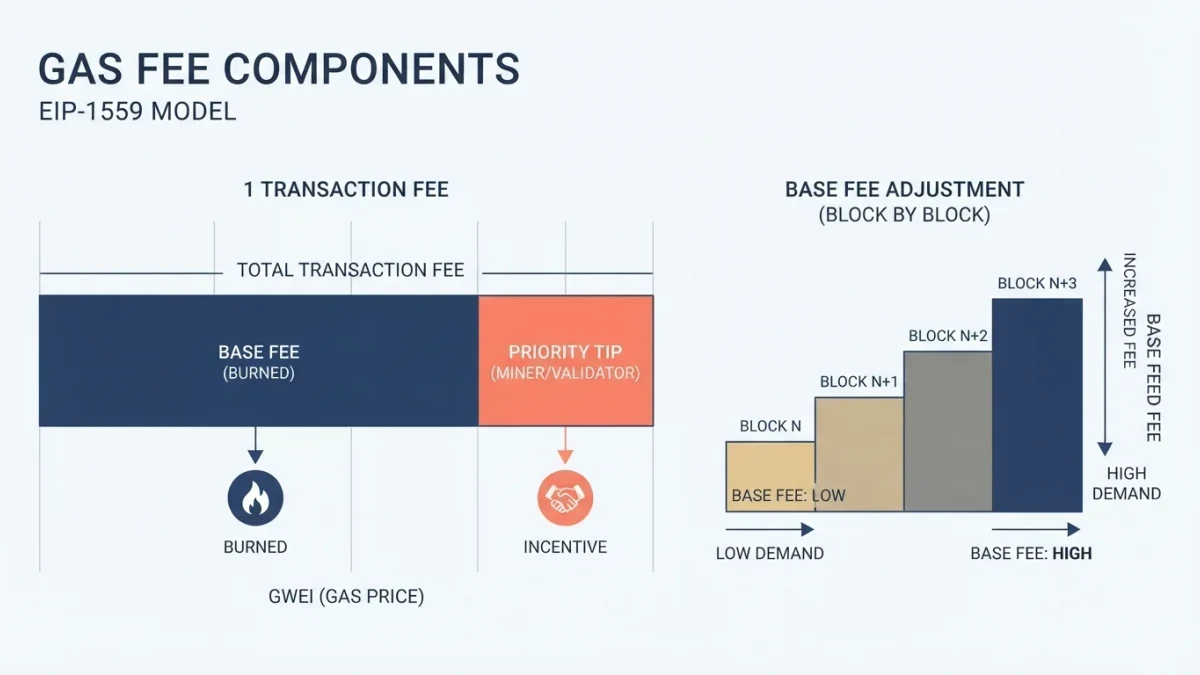
Fee equals gas used multiplied by the price per unit of gas. A plain ether transfer consumes a fixed 21,000 gas; a complex swap can burn hundreds of thousands. Price is set in gwei — billionths of an ether. Since August 2021, the price splits into a base fee set by protocol and a tip you add.
The meter analogy is close but imperfect — think of gas as electricity units on a meter — so here is the precise version: gas is a count of computational steps the network must perform, and each step has a fixed cost in the protocol's rules. A transfer is a small, constant amount of work. A contract that loops through records is a large, variable amount. You pay for work performed, whether the transaction achieves what you wanted or not.
That last clause is the one that stings. A failed transaction — a swap that hit an error, a mint that sold out before it confirmed — still consumed the network's computation, so the gas is charged anyway. Success and payment are separate events.
Wallets package this into an estimate you approve before sending: a gas limit (the most you will pay for) and a price. Under the post-2021 rules, the price component is the protocol's base fee plus your optional tip for faster inclusion.
Why do fees spike so suddenly?
Because capacity is fixed and demand arrives in waves. A hyped token launch, a market crash, or a popular mint can stuff the queue in minutes, and bidders outbid each other for the next block. It is an auction, so the clearing price can move several-fold in an hour — and back down just as fast.
The wave sources are predictable. Broad market moves — crashes especially — send everyone to their wallets at once. Scheduled events like token launches or collection mints concentrate thousands of buyers on the same minutes. And some waves are manufactured: bots fighting over arbitrage or minting opportunities bid fees up as a cost of doing business, and everyone else pays the same clearing price.
During the 2021 boom this became routine: on peak days, simple transfers on Ethereum cost tens of dollars while complex DeFi operations cost more than the trades were worth to small users. The spikes were not malfunctions. They were the auction working, with more demand than seats.
What did EIP-1559 change in August 2021?
EIP-1559, activated in the London upgrade on August 5, 2021, replaced the pure auction with a protocol-set base fee that adjusts each block — up when blocks run full, down when they don't — and is burned rather than paid out. Tips survive for priority. The result: more predictable fees, not cheaper ones.
Before the change, users set their own price blind: too low and your transaction sat in limbo for hours; too high and you overpaid. Wallets guessed, badly. The base fee replaced the guessing — as a Reuters explainer put it ahead of the upgrade, the mechanism was designed to make fees more predictable and to burn part of the supply.
Two honest clarifications. First, predictability is not cheapness: the base fee still follows demand up and down, so congested periods remain expensive — EIP-1559 changed how the price is discovered, not how scarce the product is. Second, the burn made fee mechanics a monetary topic: base fees are destroyed, which reduces the ether supply slightly. That matters to the asset's economics; it changes nothing about what you pay at 2 p.m. on a busy Thursday.
Can fees be avoided, or only managed?
Managed, mostly. Fees track demand, so the levers are mechanical: transacting when networks are quiet, using layer 2 networks that settle many transactions in a single mainnet transaction, and batching several actions into one where an app allows it. Each lever trades something — timing, a different trust setup, or flexibility.
Timing is the simplest to explain: demand has rhythms, and fees are typically lower when the largest time zones are asleep or on weekends. It is a pattern, not a promise — a single scheduled launch can torch a quiet Saturday morning.
Layer 2s attack the capacity limit itself: they execute transactions on their own network, then post compressed batches back to Ethereum, splitting one mainnet fee across thousands of operations. The trade-offs are real — a different set of contracts and operators to trust, and moving funds between networks costs its own fees. Batching, where supported, folds multiple actions into one bill.
None of this is advice; it is mechanics. The one mechanical fact worth memorizing: fees reward patience and punish urgency, because urgency is exactly what the auction prices.
A gas fee, then, is the metered price of a shared, scarce resource. It is loud when everyone wants the same block, quiet when they don't, and predictable only in the sense that the formula for it is now public and automatic.