A smart contract is a program that runs on a blockchain and executes agreed terms automatically. Once deployed, it does what its code says — no manager, no intermediary, and no option to change its mind. That makes it powerful and dangerous at once: "smart" describes the automation, not the code's intelligence.
The usual note first: L4 News publishes information, not investment advice. Crypto assets are volatile and can lose most or all of their value quickly, and nothing in this article is a reason to buy any of them.
Where did smart contracts come from?
The idea predates blockchain apps by two decades. Computer scientist Nick Szabo coined "smart contract" in 1994, arguing that digital agreements could self-execute like vending machines: put in money, the machine releases the snack, no shopkeeper needed. Ethereum's 2015 launch turned the idea into deployable software.
Szabo's vending machine is still the best first analogy, and it is an analogy — flag it. Put coins in, a snack comes out, and the machine enforces the rules without judging anybody. The precise version: a smart contract is a program whose execution a blockchain verifies, so no single party can quietly skip a step.
Szabo was writing about digital cash before blockchains existed. What was missing was the execution environment — a neutral computer that everyone could trust to run the rules. Ethereum, launched in July 2015, became that environment: a blockchain with a built-in virtual machine where anyone could deploy programs that hold and move funds.
How does a smart contract actually work?
You deploy code to a blockchain, and the network gives it an address. From then on, anyone can send transactions to that address, and each transaction makes the code run. The contract holds balances and remembers state. Every execution is checked by the network, so it runs the same way for everyone — within the rules of that chain.
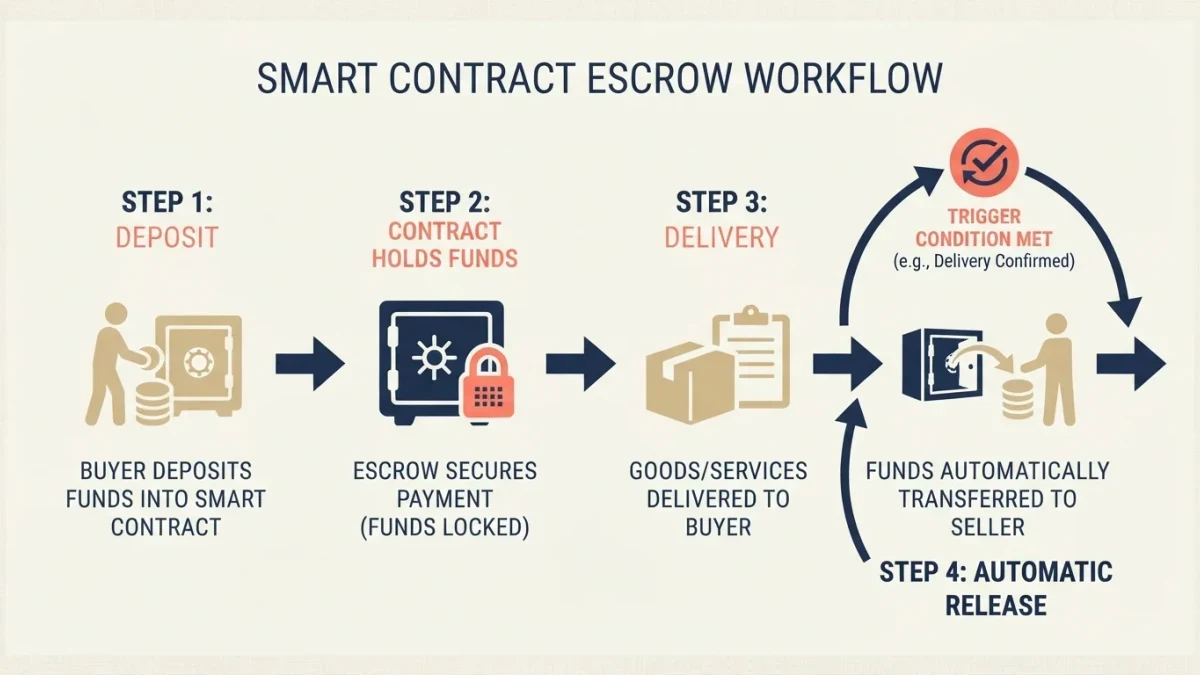
The classic teaching example is escrow — a middleman that is software. A buyer sends funds to the contract. The contract holds them. When the agreed condition is met — say, the seller marks delivery — the contract releases the funds to the seller. If the condition never arrives, the contract can refund the buyer after a deadline. Nobody holds the money in between; the code does.
Every execution costs a network fee, which is why contracts are kept short and why their logic is split into functions you call one at a time. And once deployed, the code is normally permanent: an ordinary contract on Ethereum cannot be edited, only replaced by a new deployment. That permanence is a feature when the code is right and a liability when it is not.
What does "smart" actually mean here?
"Smart" refers to self-execution, not judgment. The contract follows its code exactly, including when the code is wrong. It cannot read a room, spot an unfair term, or refuse a fraudulent instruction — humans with paper contracts sometimes can. The automation is honest; the code underneath may still be buggy.
Think of a smart contract as an extremely literal employee — an analogy, so here is the precise version: it is deterministic software. Given the same inputs, it produces the same output, every time, forever. Literalness is the whole point. It is also why a typo in a contract can behave exactly like a loophole.
There is a second limit that surprises newcomers: the chain is a sealed room. A contract cannot check the weather, a bank balance, or a delivery on its own. Data from outside has to be fed in by services called oracles — and trusting an oracle means trusting whoever runs it. Legal scholar Lawrence Lessig's 1999 line "code is law" cuts both ways here: the code rules absolutely inside its borders, and knows nothing outside them.
What happens when a smart contract has a bug?
In June 2016, a bug in a crowdfunded project called The DAO let an attacker drain about 3.6 million ether — around $50 million at the time, per Reuters. Ethereum's community voted to rewrite history with a hard fork in July 2016. The rescue worked, and it split the chain in two.
The flaw was a reentrancy bug, which is simpler than it sounds. The contract paid out before it updated its records, so the attacker's contract could keep asking for money again and again, like a turnstile that only counts every tenth person.
The fix was drastic. On July 20, 2016, Ethereum's community executed a hard fork that moved the stolen funds back to their owners. A minority refused the rewrite and kept the original chain, which still runs as Ethereum Classic. The episode set the template for every later debate: "the code is the agreement" sounds absolute until the code loses $50 million.
Most buggy contracts never make the news. They quietly lock funds, miscount votes, or pay the wrong party — and there is no support email, because there is no operator. The lesson is not that the technology is doomed; it is that the code's quality is the entire product.
What is a smart contract audit, and does it help?
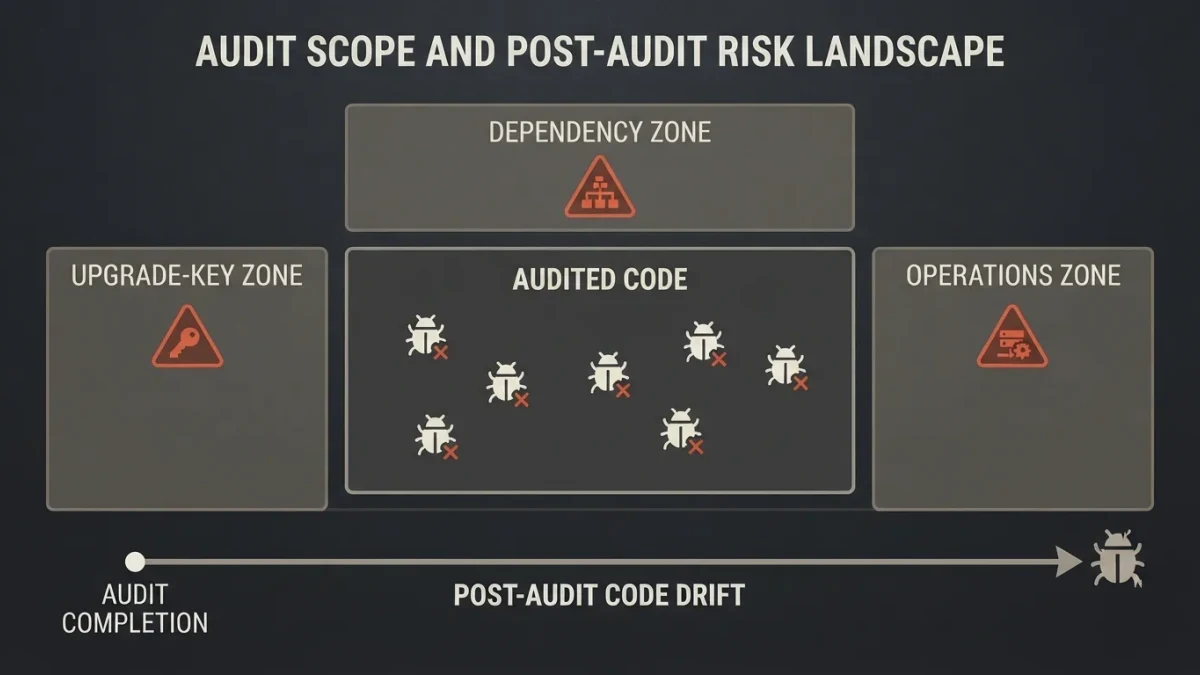
An audit is a review of a contract's code by a security firm before or after deployment: testers hunt for known bug classes and logic errors, then publish findings. It raises the bar. It is not a guarantee — audited projects have later been exploited — and it expires the moment the code changes.
A typical audit report reads like a building inspection: lists of critical, major, and minor issues, each with a suggested fix, and a re-check after fixes are applied. Good projects publish the report and the fixes. Some go further with bug bounties — standing rewards for anyone who finds a flaw — or formal verification, a mathematical proof that certain properties hold, which is expensive and rare.
What an audit cannot do is certify intent. Reviewers check what the code does, not what the project promised, not whether the token has a purpose, and not whether an anonymous team will act in good faith. An audit seal on a project with secret admin keys, an unnamed team, and an upgradeable contract tells you little by itself — read what the auditors actually checked.
So treat audits as one input, not a verdict. The questions that matter before touching any contract-driven product: is the code public, is it audited and by whom, who can change it, and what happens to your funds if the team disappears tomorrow.
The honest summary: smart contracts moved agreement enforcement from "trust a person or company" to "trust a piece of code, its authors, and everyone who will ever interact with it." That is a real trade — sometimes better, sometimes worse, never free.