Every crypto block holds thousands of transactions. How can one small computer check all of them without downloading everything? The answer is a Merkle tree, a structure that lets any block prove its own contents with a single short hash.
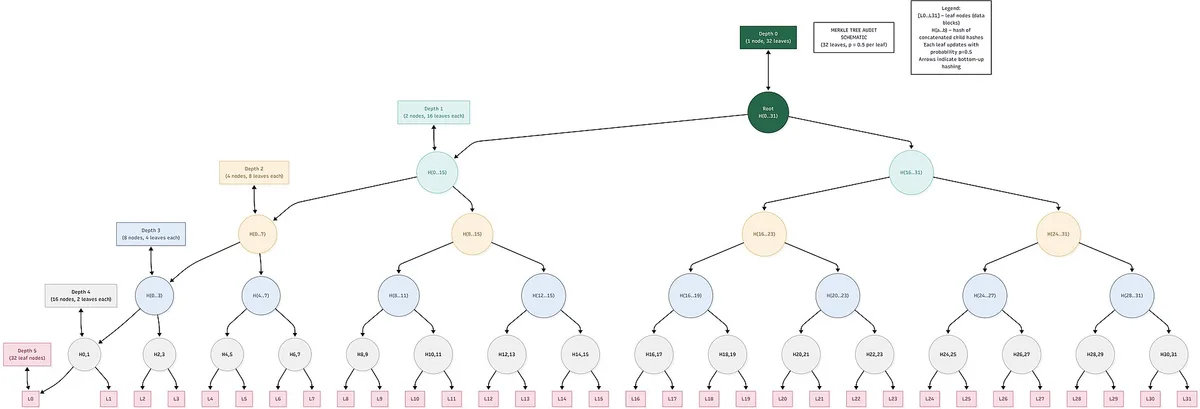
A Merkle tree is a hash tree. Each leaf holds the hash of one data block. Each branch above holds the hash of its children. The process climbs until one value is left: the root hash. Per Wikipedia's hash tree overview, this design allows efficient and secure verification of the contents of a large data structure.
How a block builds its tree
Transactions are hashed one by one, and those hashes become the leaves. Pairs of leaves are hashed together, then pairs of those results, and so on. The final value is the Merkle root, and it goes into the block header. Wikipedia's blockchain overview notes that each block stores the hash of the previous block, a timestamp, and transaction data that is generally represented as a Merkle tree.
Change one transaction and its leaf hash changes. Every hash above it changes too. The root changes with them, so the block header no longer matches. Tampering becomes easy to spot. This connects to our earlier piece, Blockchain Association changes CEOs after the Clarity Act loss: what it means and what to watch.
Proofs that stay small
The clever part is the size of a proof. To show that one transaction sits inside a block, you need only the branch of hashes beside its path up the tree. Per the same overview, this takes a number of hashes proportional to the logarithm of the number of leaves. A block with a million transactions needs a proof only about twenty hashes deep. Checking is quick, even on a phone. For related coverage, see What goes inside a blockchain block?.
A root you can treat as a seal
The root acts like a seal on the block. Per the Wikipedia source, a Merkle tree is an efficient example of a cryptographic commitment scheme: the root is the commitment, and leaves can be revealed and proven to be part of it. In a peer-to-peer network, a node gets the root from a trusted source first. After that, it can take the tree itself from anyone. If the data is damaged or fake, the hashes will not match the trusted root.
This also helps honest peers catch dishonest ones. Hash trees can check that data blocks received from other peers arrive undamaged and unaltered. They can even check that the other peers do not lie and send fake blocks.
Where Merkle trees show up
Ralph Merkle patented the idea in 1979, and it now reaches far past crypto. Per the Wikipedia overview, users include the Bitcoin and Ethereum networks, the Git and Mercurial version control tools, the ZFS file system, and NoSQL databases such as Apache Cassandra. Most implementations are binary, with two children under each node, and per the same source they usually rely on a standard hash function such as SHA-2.
Weak spots and the known fix
The design has one famous quirk. The root does not reveal how deep the tree is, so an attacker can craft a different document with the same root, which Wikipedia describes as a second-preimage attack. The fix is simple, and Certificate Transparency uses it: a zero byte goes in front of leaf hashes, and a one byte goes in front of inner hashes. With that divider, the two kinds of hashes can never be confused.
Conclusion: one hash holds it all together
Merkle trees turn a huge pile of transactions into one short value. That value seals the block, powers quick proofs, and lets light clients trust data they have not fully downloaded. When a block explorer shows a merkle root, you now know what it means: it is the anchor that binds every transaction in the block into a single, checkable number.
This article is general information, not investment or security advice. Crypto assets are volatile and may lose all value.