An NFT — a non-fungible token — is a blockchain record that represents one specific item, usually a digital file such as an image, video, or in-game object. What you own is the token: a ledger entry in your name. You do not automatically own the copyright, the file itself, or control over every copy.
Crypto assets are volatile and can lose most or all of their value quickly — the 2021 NFT boom and its long unwind are a working example — and nothing here is a reason to buy anything.
What does "non-fungible" actually mean?
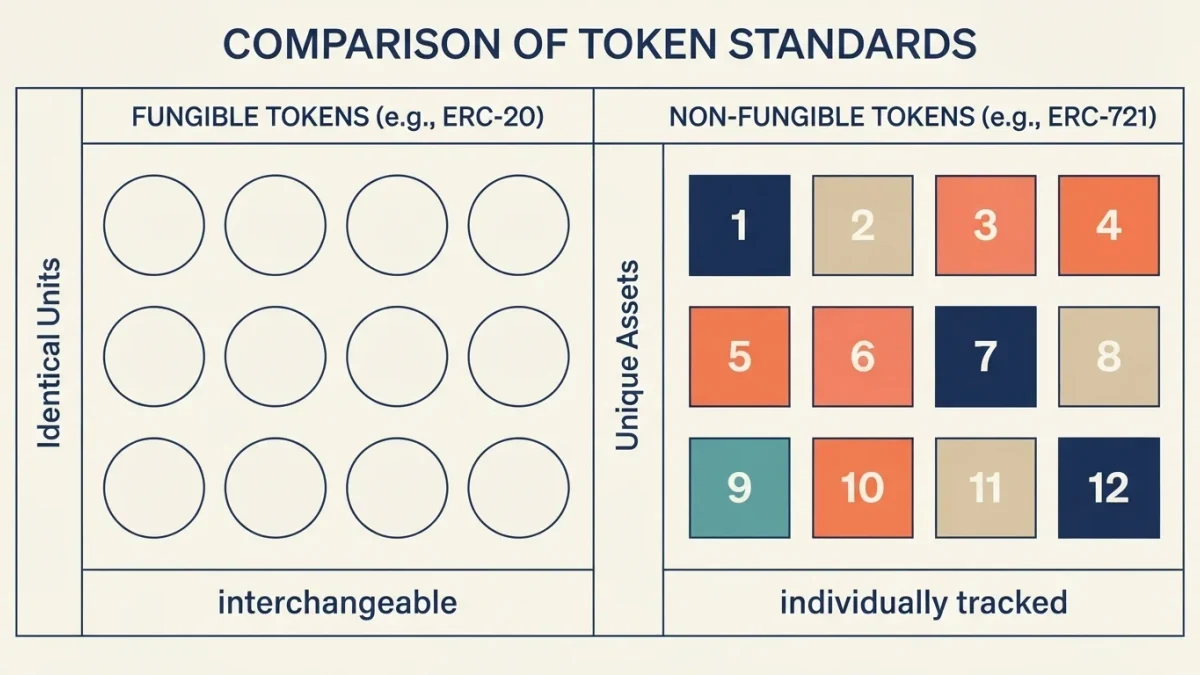
Fungible means interchangeable: any one-dollar bill is as good as any other, so they can stack and net out. Non-fungible means unique and tracked as a unit — this token, with this serial history, is not that token. It is a property of accounting, not a value judgment: uniqueness by itself makes nothing precious.
The dollar-bill framing is an analogy, so here is the precise version. On Ethereum, interchangeable tokens follow the ERC-20 standard: every token is identical and balances are just numbers. Unique tokens follow ERC-721, finalized in 2018: the contract tracks each token individually, and every one carries a history — who minted it, who held it, what it sold for. A concert ticket works the same way: same printer, same paper, but seat 3A is not seat 12F.
Non-fungibility is a design choice, not an upgrade. Event tickets, collectibles, and domain names want it; currencies and voting rights usually do not. Whether a thing should be an NFT is a separate question from whether it can be.
What happens when you buy an NFT?
A transfer happens on the blockchain: the collection's contract moves token number 47, say, from the seller's address to yours, and the network records it. That is the whole sale. Everything else — the image, the name, the traits, the listing — is data the token points to, held wherever the creator put it.
The marketplace is just a venue. It displays the item, hosts the listing, and constructs the transfer, but the ownership change itself runs through the collection's smart contract. That is why an NFT can outlive the platform it was bought on — and why "the platform shut down" and "the token vanished" are different events.
Here is the part to internalize: the blockchain guarantees the token's ownership history, and nothing else. It does not store your JPEG in some eternal vault. It stores a pointer — a link in the token's metadata — to wherever the file actually lives. The record is durable by design; the pointed-to thing is durable only if somebody keeps hosting it.
What is minting, and how does it work?
Minting is the act of creating the token. Your wallet sends a transaction to a collection's contract, pays the network fee, and the contract writes a new entry: token number, owner address, and a link to the item's metadata. The moment that transaction confirms, the NFT exists and belongs to you.
"Mint" is a coinage metaphor — the press strikes a new coin — and it is an analogy that fits loosely: a blockchain cannot forge anything physical. The precise version: minting appends a new numbered entry to a contract's registry, permanently and publicly.
Where the metadata lives matters more than most buyers check. Some projects store files on distributed systems like IPFS, where content is addressed by fingerprint — if the file changes, the link breaks loudly. Others store a plain web address that a company controls; if that company folds, the token points at nothing. "Link rot" is a real NFT failure mode, and it is checkable before you buy: look up where a collection's metadata is hosted.
Minting also costs whatever the network charges at that moment. On crowded days, the fee can exceed the mint price itself — that happened at scale during the 2021 boom.
Do you own the copyright to an NFT you buy?
Almost always, no. In the United States and most jurisdictions, copyright belongs to the creator and transfers only by written assignment. Buying the token buys the record of ownership of the token. Some marketplaces attach licenses — read each collection's terms — and a few creators dedicate works to the public domain. Default: the artist keeps the rights.
This is where the gap between the headline and the receipt is widest. A buyer who assumes "$69 million" meant "acquired the art, the rights, and the archive" has misread the product. Unless the sale includes a signed copyright assignment or an explicit license, the creator can keep printing, licensing, and selling copies — legally.
Terms vary project by project, and they are usually written into the listing or the collection's site, not into the chain. Some grants are generous (commercial use of the image), some are narrow (personal display only), and some are silent, which defaults to nothing. Read the license before assuming any right beyond "I own this entry."
Why did anyone pay $69 million for one?
On March 11, 2021, Christie's auctioned Beeple's collage "Everydays: The First 5000 Days" and it netted $69 million, as the BBC reported — the first purely digital work sold by a major auction house. The boom that followed was partly art market history, partly speculation, and the speculation part later deflated hard.
The honest anatomy of that price: a famous auction house, a well-known artist with an existing collector base, a first-of-its-kind sale, and a market flooded with newly minted crypto wealth. The record being scarce was real; the expectation that such prices would repeat was not.
And no, "right-click, save" did not break anything. Anyone can copy the image — everyone always could. The analogy is a poster versus an original painting, and it breaks down exactly here: an original canvas is physically singular, while a digital file's "original" is purely conventional — it is whatever record the community agrees to treat as the anchor. If that consensus is the entire product, then consensus lost is value lost.
After 2022, trading volumes fell dramatically from their peaks, and most collections trade far below their 2021 prices. The mechanism keeps finding quieter uses — tickets, memberships, domain-style names — where the point is a verifiable record rather than a resale bet.
The takeaway: an NFT is proof of ownership of a slot in a registry. Whether that slot is worth anything depends on what the community, the license, and the hosting say — three things no blockchain can enforce by itself.