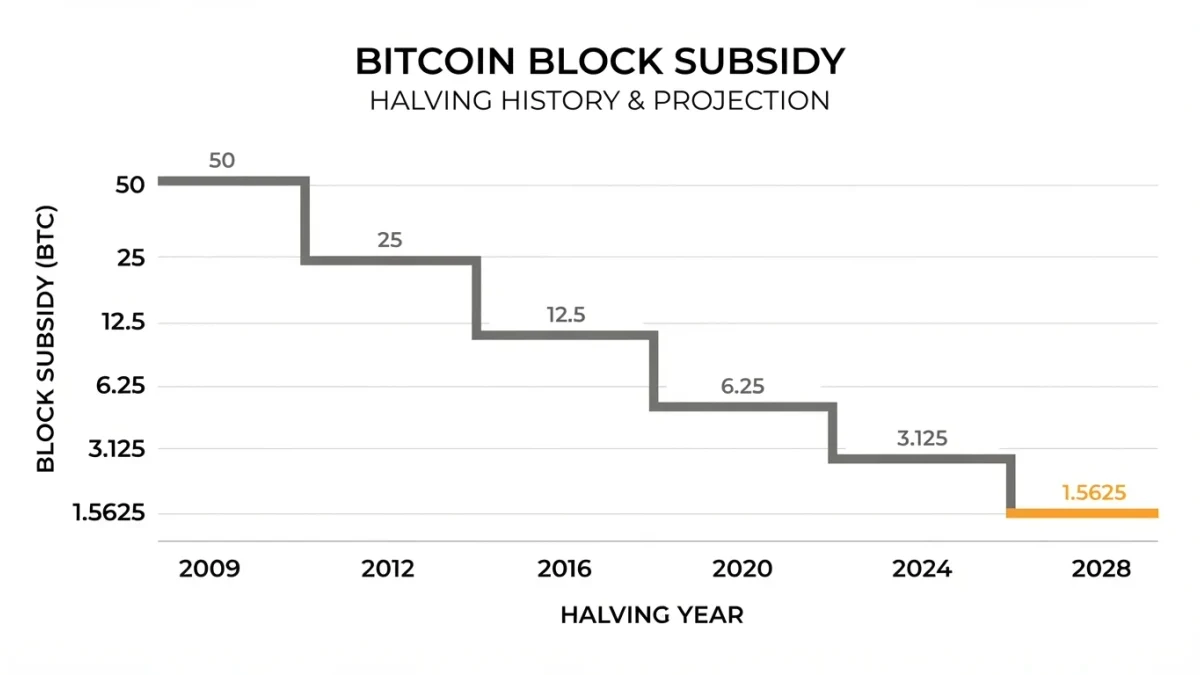
The Bitcoin halving is a protocol rule that cuts the reward for mining a block in half roughly every four years. New bitcoin therefore enters circulation on a slowing, predetermined schedule: 3.125 BTC per block since April 2024, dropping to 1.5625 BTC when the next halving is expected in 2028. The rule is written into the code.
The standing note, with extra weight here: L4 News publishes information, not investment advice. Crypto assets can lose most or all of their value quickly, and nothing on this site is a reason to buy any of them. This article deliberately contains no price forecasts, because the halving is a supply mechanic — not a trading signal.
What exactly gets halved?
The block subsidy — the fixed amount of new bitcoin paid to whoever mines each block. Transaction fees are separate and are not halved. When Bitcoin launched in 2009 the subsidy was 50 BTC; after the fourth halving in April 2024 it stands at 3.125 BTC, and it drops to 1.5625 BTC at the next halving.
The subsidy is the only faucet. There was no launch sale and no issuing company: every bitcoin that exists was either mined as a subsidy or will be, with transaction fees layered on top as the second, unhalved part of miner revenue. Economists reach for the word issuance; miners experience it as revenue per block, and each halving cuts the fixed part of that revenue overnight.
Here is the full staircase to date, with the expected next step:
| Date | Block | Subsidy before | Subsidy after |
|---|---|---|---|
| January 2009 (launch) | 0 | — | 50 BTC |
| November 28, 2012 | 210,000 | 50 BTC | 25 BTC |
| July 9, 2016 | 420,000 | 25 BTC | 12.5 BTC |
| May 11, 2020 | 630,000 | 12.5 BTC | 6.25 BTC |
| April 2024 | 840,000 | 6.25 BTC | 3.125 BTC |
| Expected around 2028 | 1,050,000 | 3.125 BTC | 1.5625 BTC |
Why is the supply schedule so predictable?
Because it is arithmetic, not policy. The subsidy halves every 210,000 blocks, and the protocol steers block production toward one block every ten minutes, which makes 210,000 blocks roughly four years. No committee meets, no announcement moves the date. As of late 2025, about 19.9 million of the 21 million cap had been issued.
The ten-minute cadence is defended automatically. Every 2,016 blocks the network compares actual production time with the target and adjusts difficulty — more miners means a harder puzzle, fewer means an easier one — so the calendar date of the next halving is always an estimate that drifts with mining pace, while the block height never changes. That is why careful writers say expected around 2028 rather than on a Tuesday in March.
The 21 million cap falls out of the same arithmetic: a geometric series of halvings starting at 50 BTC converges on 21 million total coins, with the last whole satoshis arriving around the year 2140 by the usual projections. Compare that with a central bank, which can expand supply by decision in an afternoon — the contrast is the point, whether or not one finds it persuasive.
What changes for miners?
Their subsidy income halves overnight while their electricity bill does not. Past halvings squeezed less efficient operations, and some stopped mining; the total hashrate has historically kept growing over the longer run anyway. Fees matter more each cycle, since they are the part of miner revenue the halving leaves alone.
The squeeze lands unevenly. A miner with cheap power and modern machines may still clear costs at the lower subsidy; a marginal operator with older hardware and expensive electricity may not, and past cycles have produced exactly that reshuffle — hardware migrating toward cheaper power, weaker firms exiting. Nothing about this is hidden; it is arithmetic every miner runs before each event.
The long-run question researchers debate is what happens as the subsidy shrinks toward zero: whether transaction fees alone can pay for enough security, and what fee markets look like when issuance ends. The debate is ongoing, and the honest answer is that the experiment has not finished running.
Does the halving tell you anything about price?
Nothing you can act on, and this article will not try. The sample is four events, markets knew about all of them years in advance, and past cycles do not transfer. Bitcoin's price has fallen heavily in its history and can fall heavily again. Supply schedule facts are protocol information, not a forecast.
Worth knowing how the story usually gets told, though: headlines around each halving note that past events preceded large price moves, in both directions and on small samples, and quietly skip the years-long drawdowns between cycles. Anyone treating the schedule as a promise is making a forecast, and forecasts belong to the forecaster, not to the protocol.
Every claim here is checkable, which is part of the appeal. Any block explorer shows the current height and subsidy, the interval rule is public code, and the arithmetic from 50 BTC through 1.5625 BTC to 21 million total is a homework problem, not a belief. A protocol schedule survives scrutiny precisely because it invites it.
What happens when the subsidies run out entirely?
Around the year 2140, by the usual projections, the last new bitcoin appears and miners live on fees alone. That date is far enough away that fee markets, not halvings, dominate the debate among researchers. The design always assumed fees would gradually replace the subsidy as the block reward fades.
Until then, the halving works like a metronome: a fixed event, known decades ahead, that halves the faucet nobody can reopen. For a newcomer, that predictability is the takeaway — a rare corner of the crypto story where the schedule is public, the arithmetic is checkable, and nothing depends on anyone's promises.