Block finality is the point at which a blockchain transaction can no longer realistically be reversed. Before finality, the network is still deciding: a newer, heavier chain of blocks could replace the one carrying your payment. After it, reversal would require an attack so expensive that public networks treat it as impossible in practice.
One housekeeping note first: L4 News publishes information, not investment advice. Crypto assets can lose most or all of their value quickly, and nothing on this site is a reason to buy any of them. Waiting for finality protects a payment from reversal; it protects nothing about an asset's price.
Why are blockchain transactions reversible at first?
Because the network has not finished choosing between rival versions of history. Two miners can find blocks nearly simultaneously, briefly producing two competing branches. The protocol resolves this by following whichever branch accumulates more work, and transactions from the losing branch drop back into the queue. Until then, nothing is settled.
Agreement across a planet-sized network takes minutes, not milliseconds. A block announcing new transactions needs time to reach every participant, and until a majority has built on top of it, an alternative version can still theoretically win. That is why the first minutes of any blockchain payment are a negotiation rather than a receipt.
Think of it like ink drying on a signed cheque — the analogy breaks down here: drying is gradual and passive, while blockchain settlement is stepwise and adversarial. Progress arrives in discrete blocks, and each one is a small battle won by whichever version of history more computing work backs.
When is a Bitcoin transaction considered final?
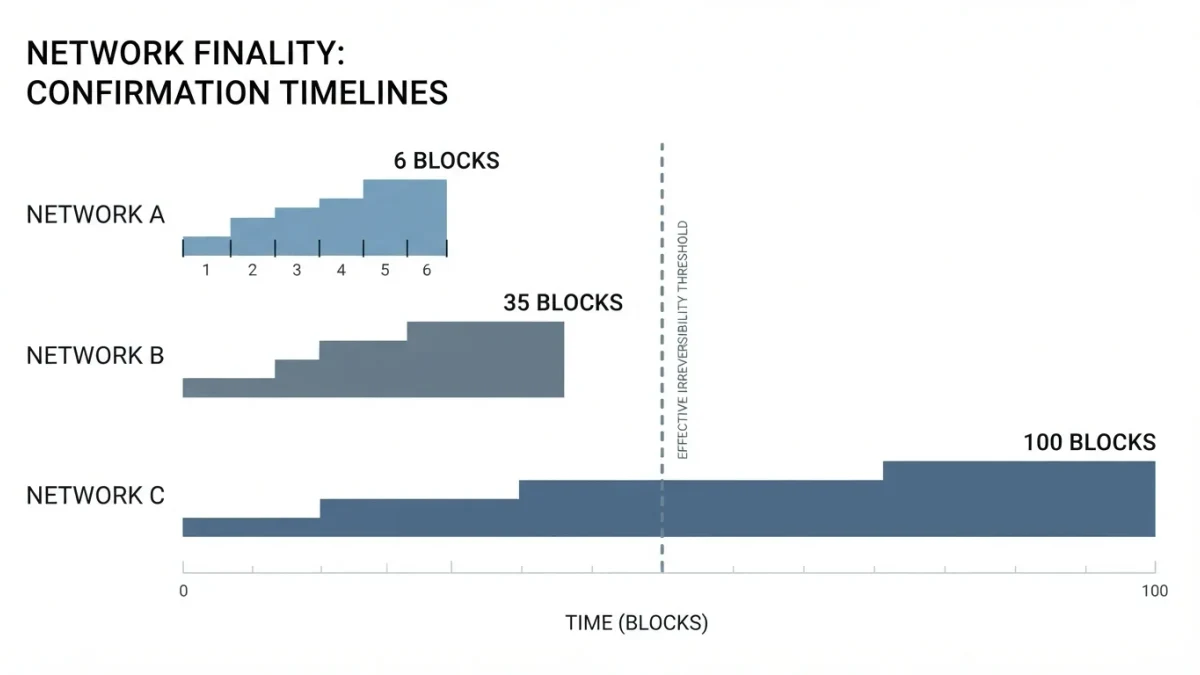
Never by mathematical decree — finality on Bitcoin is probabilistic. Each new block buried under it makes reversal exponentially more expensive. The working convention, older than most exchanges, is six confirmations: roughly one hour at the ten-minute block cadence. Services handling large sums often wait longer, as several exchanges do.
Six was never magic. The 2008 Bitcoin whitepaper included arithmetic on how quickly an attacker's odds of catching up collapse as blocks stack up, and early users picked six as a comfortable margin for everyday amounts. The number stuck as convention, not as protocol.
What the protocol does enforce is the cost curve. To reverse a block buried under six others, an attacker must regenerate all seven blocks of work before the honest network notices and outpaces them — an expense that grows with every additional confirmation. Finality on Bitcoin is a probability that rounds to certainty, not a signed certificate.
Do all blockchains finalize at the same speed?
No, and the reasons are architectural. Bitcoin leans on probability and depth. Since its September 2022 Merge, Ethereum uses an explicit finality rule: validators vote in rounds, and blocks that clear two epochs — roughly thirteen minutes under normal conditions, per Ethereum's documentation — cannot be removed without massive penalties.
Ethereum's version has teeth called slashing. A validator who finalizes two conflicting histories burns part of its deposit, so the protocol does not merely make reversal expensive in electricity — it makes it financially self-destructive. Other chains accept faster finality with different assumptions, often smaller validator sets or different quorum rules; the trade between speed and the strength of the guarantee is the actual design decision.
| Bitcoin | Ethereum (post-Merge) | |
|---|---|---|
| Finality model | Probabilistic: depth makes reversal exponentially costlier | Explicit: validator votes finalize blocks, backed by slashing |
| Everyday convention | Six confirmations, roughly one hour | Two epochs, roughly thirteen minutes in normal conditions |
| Guarantee type | Economic improbability of reversal | Irreversibility enforced with deposit destruction |
| In force since | Network launch, January 2009 | The Merge, September 15, 2022 |
What is a chain reorganization?
A chain reorganization is what happens when one branch of blocks overtakes the one everyone was following, and the network switches to it. Transactions from the abandoned branch re-enter the queue — unless an attacker arranged both versions, spends the coins on one, and keeps the other. That is a double-spend.
Shallow reorganizations happen on healthy networks all the time: two blocks found at once, one branch winning within a block or two. Explorers log them without ceremony, and nobody's payment fails — it simply waits one block longer.
Deep reorganizations are different, and they have happened on chains with modest security budgets. In January 2019, Coinbase disclosed repeated deep reorganizations on Ethereum Classic, paused deposits, and attributed roughly 1.1 million dollars in double-spends to the attacker. The same chain suffered further organized attacks in August 2020, months apart, each rewriting stretches of recent history.
What does finality mean for you in practice?
Mostly, patience. A transaction with zero or one confirmation is not yet settled; a pending status usually means the network is busy, not that your funds vanished. High-value transfers deserve more confirmations, and exchanges credit deposits only after their own thresholds. Finality is simply the point where waiting stops being necessary.
A few practical habits follow. Check the confirmation count in a block explorer rather than refreshing your wallet in alarm. Expect exchanges to publish per-chain deposit thresholds — those are platform policies, not protocol rules, and they change when networks misbehave. And treat any service promising to skip waiting times with suspicion; the waiting is the security.
The larger lesson is about expectations. Card networks settle days later and banks dispute charges for months; blockchains trade that flexibility for a schedule you can read in advance. Finality is the timestamp where a blockchain keeps the promise the technology was built to make.