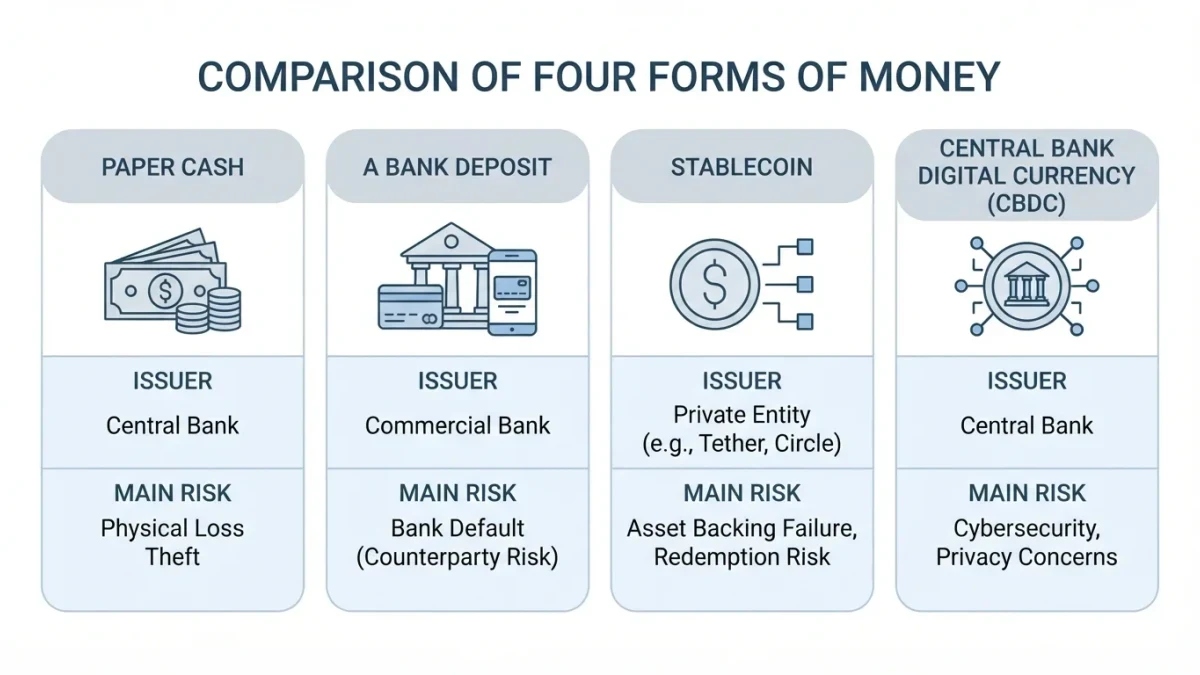
A central bank digital currency (CBDC) is digital money issued by a central bank itself, making it a direct claim on the same institution that stands behind paper cash. Nothing is mined, and no private company sits in the middle. The idea is banknote-grade money in digital form; whether that is a net benefit is debated.
CBDCs are not crypto assets, and this explainer is not an argument for or against them — crypto assets can lose most or all of their value quickly, while a CBDC's stated goal is the opposite: no volatility at all.
How is a CBDC different from crypto like bitcoin?
The issuer is the difference. Bitcoin has no central issuer and runs on a public network anyone can validate; a CBDC is a liability of one institution, recorded on infrastructure that institution controls or licenses. Bitcoin's supply is fixed by protocol; a CBDC's supply is a policy decision, exactly like cash today.
Think of bitcoin as email — an open system nobody owns — and a CBDC as a government-run postal service for money. The analogy breaks down at censorship and access: email is hard to switch off, while a centrally run system can be, and that is precisely what the privacy debate is about.
There is also no investment story inside a CBDC by design. One digital euro or one e-CNY aims to be worth exactly one euro or one yuan. Central banks have repeated that a retail CBDC is a payment instrument, not an asset to trade — a deliberate contrast with volatile crypto assets.
How is a CBDC different from a stablecoin?
A stablecoin is a private promise: a company or protocol holds reserves and owes you a dollar. A CBDC is a public liability: the central bank owes you the money directly, so there is no issuer whose failure could break the peg. The middleman disappears — along with the middleman's balance sheet risk.
That is the theoretical appeal. In practice, stablecoins as of 2025 were already moving tens of billions of dollars a day, while retail CBDCs were still pilots with modest adoption. Design questions — wallet limits, offline payments, privacy tiers — have slowed launches more than the technology did.
What do retail and wholesale CBDC mean?
Retail CBDC is digital cash for everyone, held in wallets the public uses for everyday payments. Wholesale CBDC is reserved for banks and financial institutions, settling large transfers between them on central bank rails. Most live projects are retail; most serious experimentation in big financial centers is wholesale.
The split matters because the two answer different problems. Retail CBDC competes with cards, cash, and stablecoins for ordinary payments. Wholesale CBDC competes with the plumbing banks already use for settlement — and is where projects with the major central banks of Japan, China, the euro area, and others have spent their pilot hours since the mid-2020s.
Where do CBDC projects actually stand?
Further along than most headlines suggest, but slower than the loudest predictions. As of 2025, public trackers counted more than a hundred economies researching CBDCs, a handful of small ones live — the Bahamas launched the Sand Dollar in 2020, Nigeria followed with the eNaira in 2021 — and the two largest experiments, China's e-CNY and Europe's digital euro, in different stages of preparation.
China's e-CNY is the largest pilot. Per People's Bank of China figures cited in June 2025, cumulative e-CNY transactions had reached about 7 trillion yuan, with the pilot operating across dozens of cities. Adoption outside promotions and government payouts remained limited — a pattern small-country CBDCs also hit.
The digital euro is still a decision, not a product. The European Central Bank opened its preparation phase in November 2023 and, per its October 2025 announcements, moved the project to a next phase focused on rulebooks and pilot preparations, with an issuance decision possible in late 2026 and actual issuance years later.
The United States stepped back. The Federal Reserve's January 2022 discussion paper stressed it would not issue a CBDC without congressional direction, and a January 2025 executive order prohibited federal agencies from pursuing one. As of early 2026, the U.S. had no active retail CBDC project.
What worries critics of CBDCs?
Three things, mostly about retail versions: privacy, programmability, and bank funding. Privacy, because a central ledger could in principle see every payment. Programmability, because money that is software could carry rules. Bank funding, because if households shift deposits to the central bank, commercial banks lose a cheap funding source.
Central banks have answered each point in their design papers: intermediated rather than direct holdings, stated commitments that a digital euro or e-CNY would not collect payment-level data centrally, and wallet caps to slow any deposit migration. Whether the commitments hold is a governance question, not a technical one — the honest answer for a newcomer.
| Cash | Stablecoin | CBDC | Bitcoin | |
|---|---|---|---|---|
| Issuer | Central bank | Private company or protocol | Central bank | No issuer |
| Value | Fixed by definition | Pegged, can depeg | Fixed by definition | Market price |
| Ledger | None (bearer) | Public blockchain usually | Central bank system | Public blockchain |
| Main risk | Loss, theft | Reserve and issuer risk | Privacy and design choices | Total loss of value |
What should a newcomer remember?
A CBDC is a payment project by monetary authorities, not a cryptocurrency with better branding. If one arrives in your country, using it will likely feel closer to a wallet app than to anything on a blockchain. The debates worth following are privacy, limits, and choice — and those are decided in policy documents, not in code.