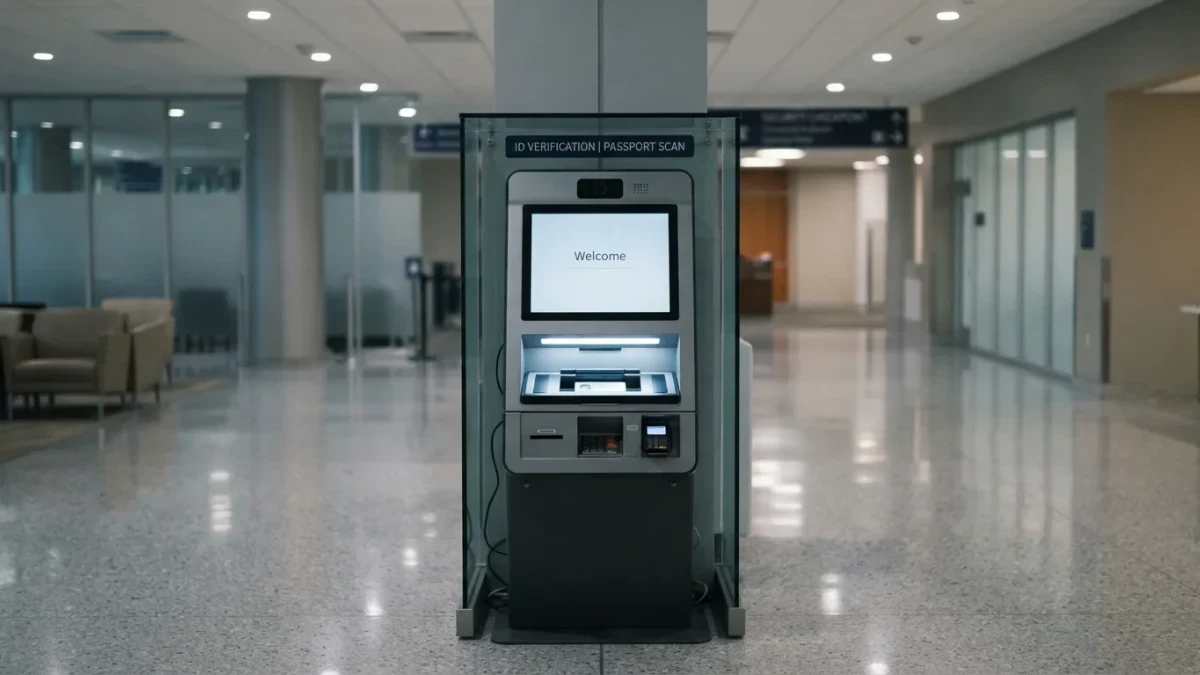
KYC — know your customer — is the identity verification process that regulated crypto exchanges must run before letting you trade: your name, date of birth, address, a government ID, sometimes a selfie or proof of address. In the United States it descends from the Bank Secrecy Act's anti-money-laundering rules. Its goal is compliance, not exposing you personally.
L4 News publishes information, not legal or investment advice. Verification is a fact of regulated platforms, not an endorsement of any exchange — and whatever the paperwork, crypto assets can lose most or all of their value quickly.
Why do exchanges ask for my passport or driver's license?
Because the law treats them like other money businesses. A U.S. crypto exchange generally registers as a money services business with FinCEN, the Treasury's financial crimes unit, and must run a risk-based anti-money-laundering program that starts by identifying who the customer is. No verified identity, no account.
The rules are older than crypto. The Bank Secrecy Act dates to 1970, and the USA PATRIOT Act of 2001 added the Customer Identification Program requirement — the CIP that financial institutions use to collect and verify identifying details. FinCEN guidance from 2013 and 2019 confirmed that virtual-currency exchangers count as money transmitters under those same rules.
What exactly are exchanges required to do?
Four duties, in outline. Identify customers and verify them with documents. Monitor transactions for patterns that suggest money laundering or sanctions exposure. Report cash transactions above $10,000 through currency transaction reports, and flag suspicious activity through confidential suspicious activity reports. And keep records regulators can inspect.
Suspicious activity reports deserve a plain-language note: they are filed secretly, and it is illegal for a bank or exchange to tell you that one was filed about you. That secrecy is by design — advance warning would defeat the reporting — and it is one reason customer-service agents cannot explain sudden account freezes.
What is the travel rule?
A recordkeeping rule for moving money. Under the Bank Secrecy Act's funds-transfer rules, financial institutions must exchange and retain certain originator and beneficiary details for transmittals of $3,000 or more. The Financial Action Task Force, the global standard-setter, extended the same idea to virtual assets in 2019 — the crypto version everyone calls the travel rule.
In practice, the travel rule means that when you send a large transfer between two regulated platforms, the sending platform passes your name and account details to the receiving one, like a wire transfer's paper trail. Compliance rollouts were uneven through 2025 — implementing it between different exchanges' systems proved harder than the rule's one-line description suggests.
What do regulators actually see about me?
Not a live feed. Your identity documents sit in the exchange's records; a regulator or prosecutor generally needs legal process — a subpoena or examination authority — to obtain them. What is public without any paperwork is the blockchain itself: every on-chain transaction is visible, and analytics firms routinely link addresses to services.
That is the honest geometry: KYC ties your identity to your exchange accounts, while the public ledger ties addresses to each other. Where the two meet — a withdrawal from a verified account to your wallet — is the seam privacy tools and court cases both revolve around. KYC did not create the visibility; it organized the filing cabinet.
Can I use crypto without KYC?
Self-custody itself requires no identity check — a wallet is software, not an account. Peer-to-peer trades, bitcoin ATMs within limits, and earning or receiving crypto all happen outside verification flows. The KYC gate stands at the on-ramp where fiat money meets regulated businesses, not across the technology.
The choice carries trade-offs in both directions, and L4 News does not make it for you. Skipping verification can mean thinner markets, weaker recourse if a trade goes wrong, and exposure to platforms operating outside any supervisory net — the same net that exists to catch the failures. What it does not change is the public ledger under everything.
| What KYC does | What it does not do |
|---|---|
| Verifies who opens an exchange account | Identify wallet holders who never use a regulated service |
| Feeds legally required reports to FinCEN | Give regulators automatic access to your documents |
| Supports sanctions and fraud screening | Prevent scams, rug pulls, or market losses |
| Enables travel-rule data sharing between platforms | Hide or reveal anything the public blockchain shows |
Why does verification sometimes freeze or fail?
Mismatched data and risk flags. If the name on your ID differs from your bank account, or your device and login patterns resemble fraud patterns, automated checks stall the account pending manual review — which can take days. Verification systems err toward caution because the institution, not you, bears the regulatory cost of a mistake.
EU readers get an extra layer: the MiCA regime in force since December 2024 folds customer due diligence into its licensing rules for crypto-asset service providers, so verification steps on licensed platforms follow the same logic as banks. The paperwork differs in detail across countries; the direction is the same.
Can you use crypto without handing over documents?
Yes, in narrow places. Holding crypto in your own self-custody wallet does not normally involve a KYC check, because no regulated intermediary is holding it for you. The trade-off is responsibility: if you control the keys, you also carry every recovery and security burden yourself, and the on-ramps that convert fiat currency usually still run checks.