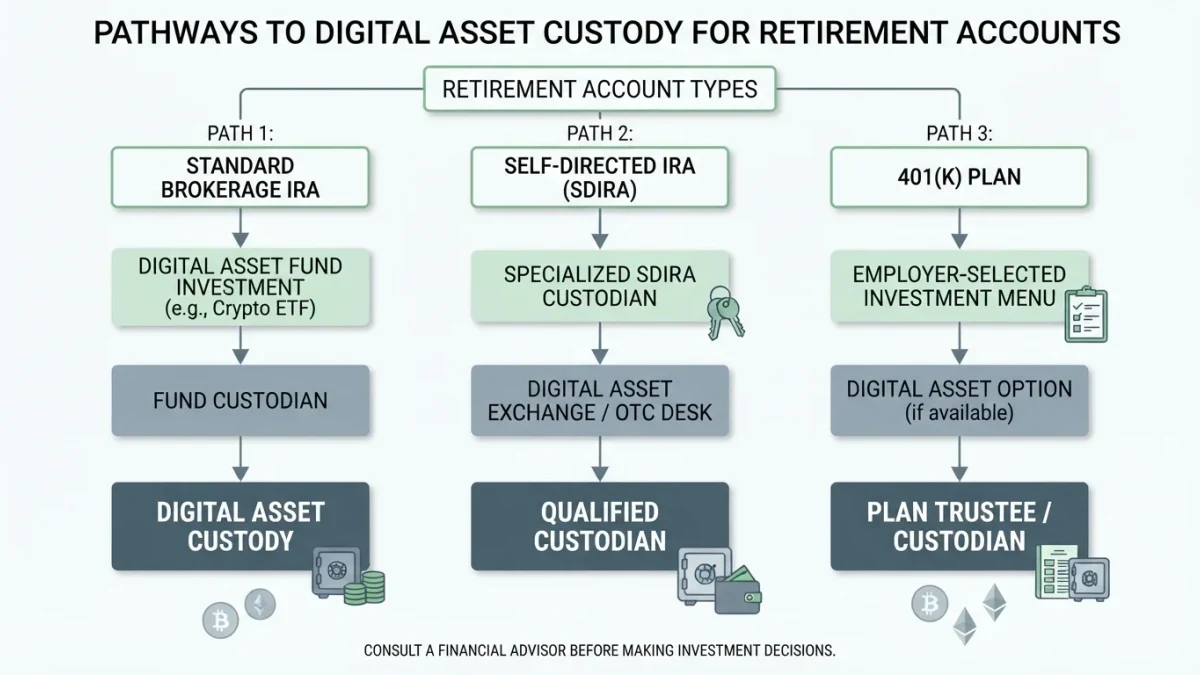
Crypto in retirement accounts is possible in the United States mainly through a self-directed IRA or a 401(k) whose sponsor explicitly offers a digital asset option. It is technically possible and structurally heavier: specialized custodians, higher fees, and strict prohibited-transaction rules that can disqualify an IRA entirely. What follows is information, not a recommendation.
L4 News publishes information, not investment or tax advice. The stakes are larger here than curiosity: retirement money, penalties for mistakes, and an asset class where crypto assets can lose most or all of their value quickly — inside any account wrapper.
Can I hold crypto in an IRA?
Yes, through the right wrapper. A standard brokerage IRA offers stocks and funds, not crypto directly; a self-directed IRA is an IRA whose custodian permits alternative assets, including digital assets. Trades inside the IRA do not trigger capital gains tax each time — that is the wrapper's core feature, for better or worse.
The custodian point is not a detail. IRA rules require assets to sit with a qualified custodian or trustee, so the coins are held by the specialized provider — or through structures like an IRA-owned LLC that the account directs, a route with its own risk map below. Either way, you personally should not be the one holding the keys to IRA coins.
Can I hold crypto in a 401(k)?
Only if your employer builds the door. A 401(k)'s investment menu is chosen by the plan sponsor, and crypto options appeared slowly: Fidelity added a digital asset option for plan sponsors in April 2022, the first major provider to do so, and the Labor Department the same month issued a compliance release urging extreme care for fiduciaries offering crypto to 401(k) participants.
Adoption stayed modest through the mid-2020s: most plans did not add digital asset menus, and the sponsors that did often capped allocation percentages. If your plan offers nothing, the practical answer ends there — rolling over to a self-directed IRA is a separate decision with its own trade-offs, not a step this explainer urges.
What is a self-directed IRA, really?
An IRA with a wider permissions list. The account follows the same contribution limits and distribution rules as any IRA; what changes is the custodian's charter to hold alternatives — real estate, private shares, and crypto among them. Think of it as the same garage with a bigger door; the analogy breaks down because bigger doors let bigger mistakes through, and the rules do not shrink.
Quality varies across providers. Fees commonly include setup charges, annual administration fees, and sometimes asset-based or transaction fees layered on top — a structure that matters more for volatile, frequently traded assets. Regulators including state securities authorities have repeatedly warned about self-directed IRA fraud, because the wrapper's flexibility cuts both ways.
Which rules can break the account?
Two families. Prohibited transactions — the tax code's list of self-dealing moves — include buying assets from your own IRA, using IRA crypto personally, or transacting with disqualified people like close family. Commit one and the IRA can be treated as distributed: taxes and early-withdrawal penalties at once.
The second family is leverage. If the account uses debt — margin, borrowed positions, an LLC with loans — unrelated business income tax can apply to the leveraged portion, producing a tax bill inside an account people open precisely to defer taxes. The line between arrangement and violation is thin enough that practitioners treat it as a professional-judgment zone, not a do-it-yourself map.
What about distributions and required minimum distributions?
Retirement accounts eventually force money out. Required minimum distributions generally begin at age 73 under the SECURE 2.0 framework, and meeting them with crypto means selling enough each year — or navigating in-kind transfers whose valuation and reporting the IRS has specific forms for. Illiquidity becomes a planning problem the year it stops being hypothetical.
Valuation runs through the whole account. RMDs, charitable distributions, and estate settlements all need a defensible fair market value, and crypto's price swings make December's number a moving target. Custodians provide statements; the account owner owns the consequences.
| Brokerage IRA | Self-directed IRA | 401(k) with crypto option | |
|---|---|---|---|
| Crypto access | Indirect at best (funds, ETFs) | Direct, via specialized custodian | Only what the menu offers |
| Who decides | You, within the menu | You, broadly | Employer and plan fiduciaries |
| Fees | Typically low | Setup, annual, transaction | Plan-dependent |
| Key risk | Option not offered | Prohibited transactions, provider quality | Fiduciary caution, caps |
What should someone take away before acting?
That possible is not the same as suitable. The mechanics exist, the fees are real, the rules are unforgiving, and the underlying asset remains one that can lose most or all of its value quickly. Anyone considering this route faces a checklist — custodian due diligence, fee schedule, prohibited-transaction boundaries, distribution math — that belongs with qualified professionals, not with a webpage.
What questions should you ask before crypto goes into a retirement account?
Start with the plan documents, because they govern what is allowed, not what a provider advertises. Ask which custodian holds the assets, what the annual fees are, how quickly you could sell in a downturn, and what happens to the position when the account changes hands. Fees inside specialty accounts are often higher than in ordinary brokerage accounts, and compounding works against you when they are. This site publishes information, not investment or tax advice, so treat these as questions to bring to a qualified professional.