You verify a crypto website by getting to it through a URL you typed yourself or a bookmark you saved earlier, then reading the domain character by character before you connect a wallet. The padlock icon does not prove a site is real — it only proves your connection to it is encrypted, and scammers get certificates too.
These steps reduce your exposure to phishing; they do not remove it. Treat them as habits rather than a one-time setup.
Why can't I trust the first search result?
Because attackers pay for ads that sit above real results and point to look-alike domains. Search engines remove many fake crypto ads, but new ones appear faster than the cleanup. The sponsored slot proves an advertising budget, not legitimacy — treat every link in search results, chats, and emails as unverified until you have checked the domain yourself.
Phishing operators buy placement for searches like 'crypto exchange' or wallet support queries, and their pages sit above the genuine results. The domain in the ad is one character off, or ends differently, and the page itself is a copy of the real interface.
This family of tricks is called typosquatting: registering domains built on small misreadings. A zero standing in for the letter O, a lowercase l for a capital I, the letters 'rn' pressed together to look like an 'm,' or an extra hyphen in a name that usually has none. Read quickly, they all pass.
Doesn't the padlock mean the site is secure?
No. The padlock means the site has a TLS certificate, which encrypts traffic between you and the server. Anyone can obtain a basic certificate in minutes, for free, including phishing operators. Encryption protects the channel, not the people at either end — think of it as a sealed envelope: sealed, but addressed by whoever asked for it.
A certificate is issued to a domain, not to a reputation. Certificate authorities verify control of the domain — that the applicant can serve traffic from it — not that the applicant runs an honest business. Free automated certificates made encryption universal, which is good for everyone, including scammers.
So the padlock answers one narrow question: can someone between you and the site read this traffic? It says nothing about who runs the site or what the 'Connect wallet' button will ask you to sign.
How do I check a crypto website, step by step?
Work through these in order, and repeat them every time a site asks you to connect a wallet or type a password. The whole sequence takes under a minute once it becomes habit.
- Type the domain yourself or open your saved bookmark. A bookmark is only as good as the moment you created it — save bookmarks from a page you reached through the project's official channel, never from an email, a chat message, or a search ad.
- Read the domain right to left, up to the first single slash. The registered name is the part immediately before it: in 'wallet.example.com/login,' that is 'example.com.' Attackers hide their real domain inside the subdomain, as in 'wallet-com.login.example.net.'
- Read it character by character, out loud if it helps. Watch the classic swaps: zero for O, lowercase l for capital I, 'rn' for 'm,' doubled or missing letters, unexpected hyphens. One wrong character means a different site.
- Cross-check against a second, independent source. The project's own documentation, its official app-store listing, or a link you already use and trust. Caveat: official accounts get compromised too — two sources that trace back to the same hacked channel are not independent.
- Treat any request for your recovery phrase as the final alarm. No real site, extension, or support agent needs those twelve or twenty-four words, ever. If a page asks for them, you are on an attack page whatever it looks like — leave without typing anything.
Why do bookmarks work so well?
Because a bookmark freezes the domain check into a one-time decision. If you saved the correct URL after verifying it once, every later visit bypasses search results, chat links, and typo-prone typing. The caveat: bookmarks protect you only if the original save was correct and your browser stays free of malware that edits them.
Move the moment of verification to a calm setting — once, when you are unhurried and reading carefully — and that decision replays itself on every later visit. No sponsored slots, no pressure, no typing under time constraints. Bookmark the exchanges and wallets you actually use, today, while you are thinking about it.
Which signals actually mean something?
A few familiar signals are weaker than they look. Here is what each one really tells you.
| Signal | What it actually tells you |
|---|---|
| Padlock and 'https' | The connection is encrypted. Nothing about who runs the site. |
| Professional design | Nothing. Phishing kits clone real pages down to the pixel. |
| Top advertising slot | Someone paid for your click. Ads are not endorsements. |
| Exact domain, read character by character | The one check that matters: it is the site you meant to visit. |
Design quality in particular is worthless as evidence, because the fake is by definition a copy of the real thing. Only the domain is hard to fake: registration is the one part an attacker cannot take, only imitate closely.
What if I already logged into a fake site?
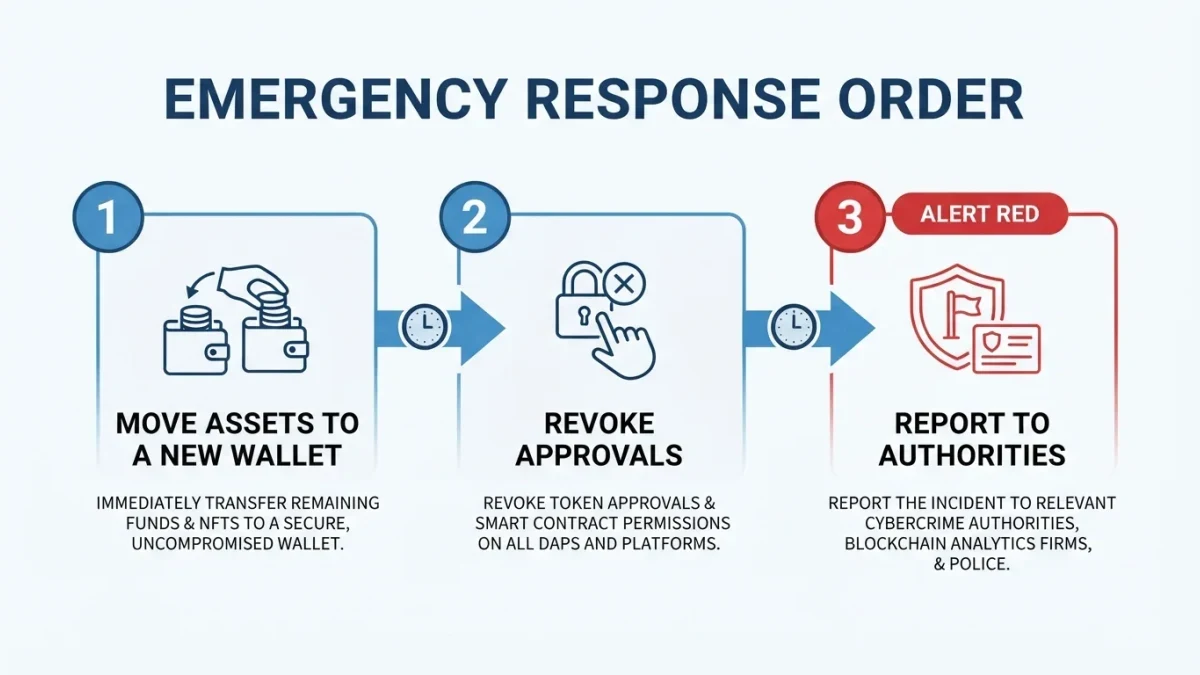
Change your password on the real site immediately — typing its address yourself — then review active sessions and turn on two-factor authentication if it was off. If you entered a recovery phrase anywhere, treat that wallet as compromised: move assets to a new wallet first, then report the site.
Change that password everywhere you reused it — exactly the scenario password managers exist to prevent. A compromised phrase cannot be reset like a password; the only fix is a new wallet.
Then report the page — to the platform that hosted the ad if you clicked one, and, if you are in the United States, to the Federal Trade Commission's fraud portal or the FBI's Internet Crime Complaint Center. Reports rarely recover funds, but they feed the cases that eventually take phishing networks down.