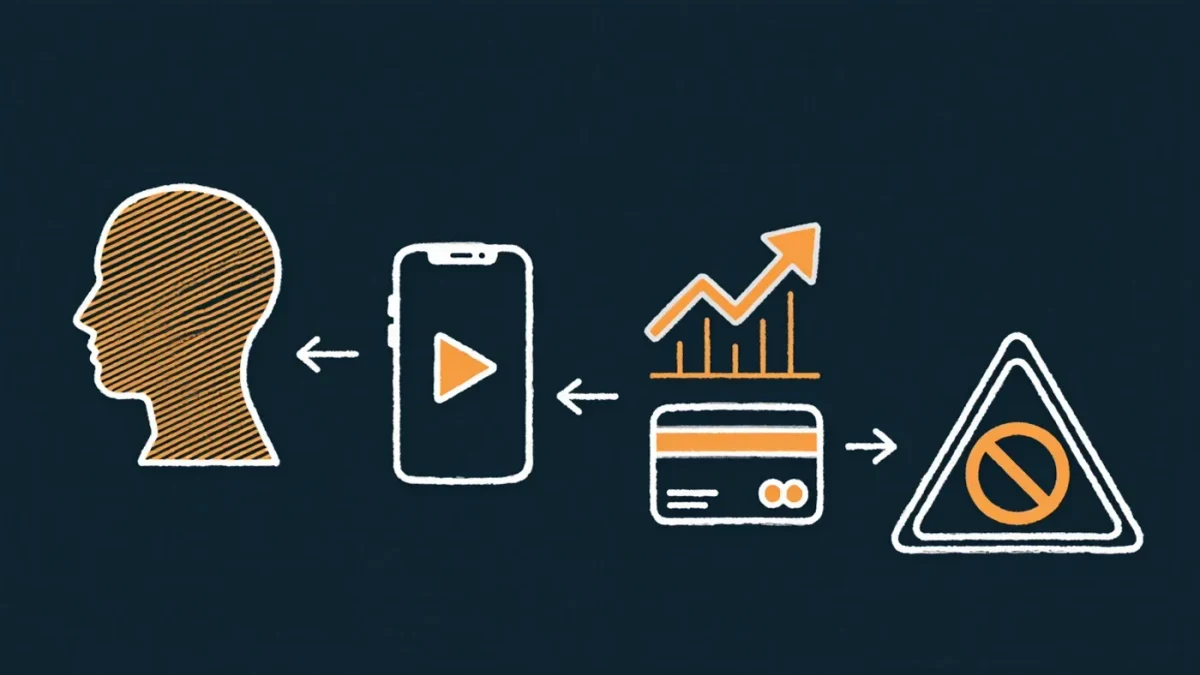

An airdrop scam is a fake token giveaway built to capture either a wallet signature with spending rights or an upfront payment you'll never see again. Real airdrops occasionally give tokens to eligible addresses for free; the fake ones invert that — you pay, connect, and approve first. The token was never the point.
L4 News publishes information, not investment advice, and airdropped tokens are assets like any others — they can lose all their value, and some exist only to be worthless. This guide covers the mechanism of the scam version, not any particular giveaway.
How do real airdrops work?
A real airdrop distributes tokens to selected addresses, usually as marketing or a reward for past use. Eligibility is typically set by a snapshot of who held or did something before a date, and claiming requires no payment to the project — at most, you pay the network's own fee. The project never needs your keys.
The best-known example set the template. In September 2020, the Uniswap exchange distributed its UNI governance token to past users of the platform — anyone who had used it before a cutoff date could claim a fixed allocation once, paying only gas. The claim page was plain, the eligibility rules were public, and the whole event was announced through the project's established channels, as widely covered at the time.
That is the shape to hold in mind: eligibility earned before the announcement, a claim that costs nothing beyond network fees, and no secrets requested — no recovery phrase, no 'unlock' payment, no approval of unfamiliar contracts.
How does the scam version work?
The fake mirrors the real until the moment of payment, then reverses it. The funnel runs in four moves.
- Contact. A reply to your public post, a direct message, a search ad above the real project, a QR code at a conference, or an unsolicited token already sitting in your wallet with instructions attached. Urgency is standard: the claim window closes soon.
- The page. A polished clone of the real project's site, with a fake countdown, fabricated 'participants,' and a big claim button. The domain is one careful look away from wrong.
- The payload. Three flavors, sometimes stacked: a wallet connection followed by an approval dialog styled as a claim; a demand to pay a 'gas,' 'verification,' or 'unlock' fee to an address the project controls; or a request to enter your recovery phrase to 'sync' your wallet. Each one is the actual product; the tokens are the wrapper.
- The exit. The site vanishes after enough victims, the domain rotates, and the campaign restarts with a new skin. Your transaction history is the only record it ever existed.
Notice what the scam never does: it never simply sends you tokens and leave you alone. Real eligibility requires nothing from you until you choose to claim; fake eligibility requires everything from you before anything arrives.
Why do scammers keep reaching for fake airdrops?
Because the cover is real. Genuine giveaways taught users that tokens sometimes do appear for free, that claim pages are normal, and that connecting a wallet is routine — each true, and each exactly the behavior the fake version needs. The scam doesn't fight the reader's experience; it borrows it.
Then it adds the two accelerants that make the channel durable: greed and haste. A 'limited allocation' that might be worth something collapses the usual caution timeline, and the countdown manufactures the decision speed that careful wallet habits are designed to prevent. Add that the payload is one confirmation deep, and the economics favor the attacker: near-zero cost per site clone, victims arriving pre-motivated.
How do I tell a real airdrop from a fake one?
Four questions separate almost every case. The trick is asking them before connecting anything, not while the dialog is open.
| Question | Real airdrop | Fake airdrop |
|---|---|---|
| Does it ask you to send crypto first? | No — at most you pay the network's own gas when claiming | Yes: 'gas,' 'unlock,' or 'verification' fees to an address |
| Does it need your recovery phrase? | Never, for any reason | Sometimes, dressed up as 'sync' or 'verify' |
| Where was it announced? | Official channels with history you can check | DMs, replies, ads, QR stickers, random sites |
| What does the wallet dialog show? | A plain claim or transfer you can read | An approval naming a contract and an amount |
Read the fourth row twice, because it is the one that decides money. A claim that requires approving a contract's right to spend your tokens is not a claim — it is a permission slip, and the 'reward' is the camouflage on top of it.
There are tokens in my wallet I never claimed — now what?
Nothing, and specifically not the thing the token wants. Unsolicited tokens arrive with metadata — a website, a ticker, an invented dollar value — and every part of that display is chosen by the sender. The value shown in your wallet is set by thin or fake markets and means nothing; the website leads to a claim page running the payload above.
Sitting unspent, the token is inert: it cannot move your other assets, cannot execute, cannot report beyond its own existence. It becomes a problem at exactly one moment — the decision to interact. Hide it in your wallet's settings if the sight of it nags, and let it expire unloved.
What if it's too late — I connected or paid?
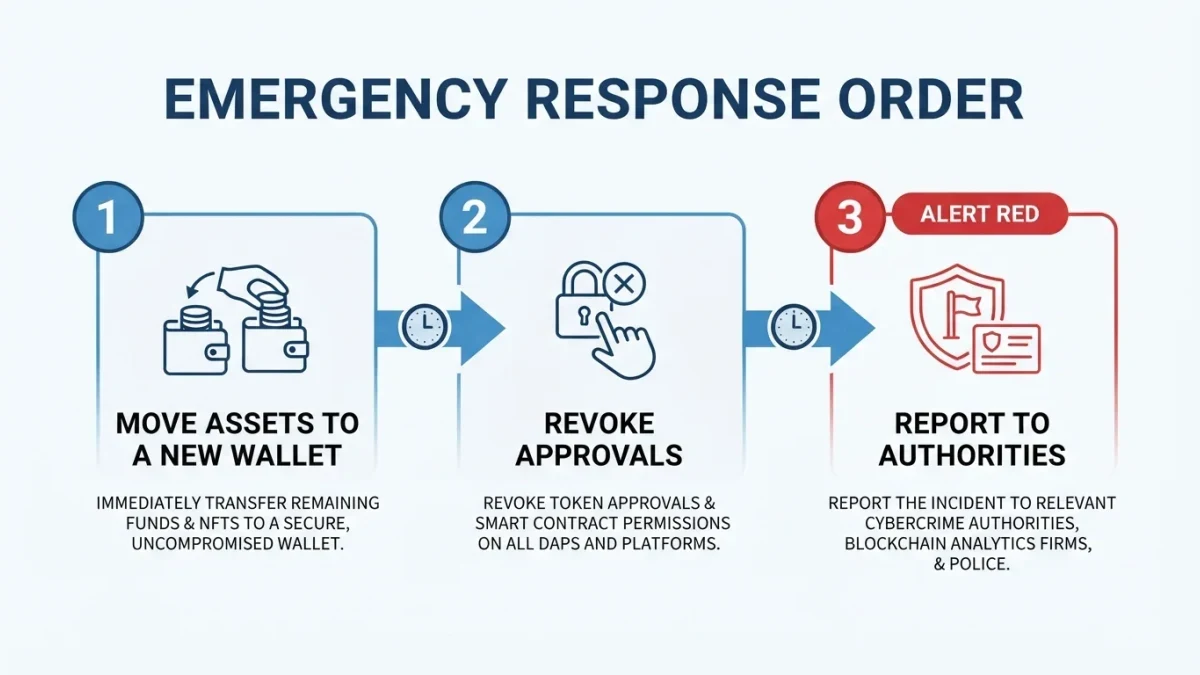
Work the damage in order. If you paid a fee: the money is gone, and it was small — that's the design; the fee is the probe, the approval is the theft. If you signed an approval: open a revocation tool you verified and bookmarked, and cancel the grant, starting with unlimited amounts on tokens you hold. If you entered your recovery phrase anywhere: stop reading, make a new wallet, move everything into it, and treat the old one as permanently burned.
Then report it. In the United States, the FBI's Internet Crime Complaint Center at ic3.gov and the FTC's fraud portal both accept crypto-scam complaints, and the reporting itself takes ten minutes with the site's URL, your wallet address, and the transaction hashes in hand. Recovery is unlikely; the report is how the pattern gets visibility — and how the next person's warning gets written.