A crypto exchange delisting is the exchange's decision to stop offering a token: the trading pairs that let you buy or sell it are switched off, and after a final withdrawal deadline the token usually disappears from the app entirely. The token itself keeps existing on its blockchain — what ends is that venue's support for it.
Crypto assets are volatile — they can lose most or all of their value quickly — and a delisting announcement is often followed by sharp price moves in both directions, which is exactly why this explainer sticks to mechanics.
What actually disappears when a token is delisted?
Three things, in sequence: the trading pairs (you can no longer swap the token for other assets on that exchange), the order books and liquidity behind them, and finally visibility — the token leaves the app's screens once withdrawals close. What does not disappear is the token on its own chain or any balance you have moved off the exchange before the deadline.
Think of a delisting like a shop taking a product off its shelves — the analogy breaks down here: a shop stops selling, but an exchange also stops being your on-ramp for deposits, and in most cases stops letting you store the asset with them at all after a cutoff date.
Why do exchanges delist tokens?
Common reasons include low trading volume, failure to keep listing information current, project abandonment, technical problems such as an insecure contract, and regulatory pressure — an exchange deciding a token is too legally uncertain to keep in a given country. The decision is the exchange's, and exchanges rarely volunteer much detail.
- Liquidity fade — too few traders to run an orderly market
- Project standing still — dead development, unanswered disclosure requests
- Technical risk — contract flaws, chain halts, failed upgrades
- Regulatory caution — classification or enforcement risk in a market the exchange serves
- Housekeeping — wallet migrations, chain support ending
Regulation as a driver became easier to see in 2026. On February 10, 2026, Reuters reported that Britain's Financial Conduct Authority had gone to court over crypto exchange HTX's promotions and asked social media companies and app stores to block UK access — a reminder that where a regulator moves, access and listings tend to follow. And when the SEC sorted crypto assets into five categories on March 17, 2026, US platforms gained a map for deciding what stays listed and how.
What happens to your tokens when a delisting is announced?
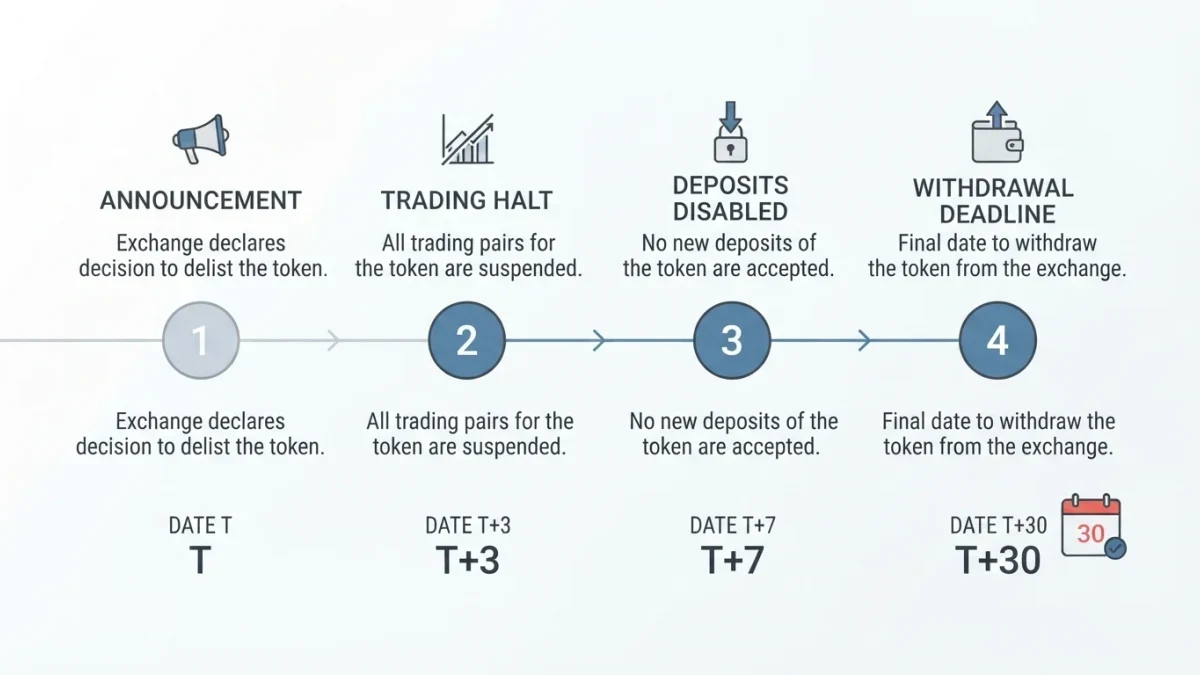
Nothing immediately — then everything, on a schedule. A typical sequence: the exchange announces the delisting with dates; trading in the affected pairs halts on a given day; deposits are disabled; and after a final withdrawal deadline, any balance left on the exchange may be converted, moved to a linked service, or become hard to access. The schedule lives in the announcement, and deadlines are the only part that matters operationally.
| Stage | What stops working | What you can still do |
|---|---|---|
| Announcement | Nothing yet | Trade, deposit, withdraw as normal |
| Trading halt | Buying and selling the pairs | Withdraw the token to your own wallet |
| Deposits disabled | Sending the token to the exchange | Withdraw; options narrow |
| Withdrawal deadline | On-exchange access to the token | Whatever the announcement specifies — conversion or recovery steps vary by exchange |
Can you still sell after trading stops?
On that exchange, no — the order book is gone. Off it, maybe: if the token trades on other venues or on decentralized exchanges, the market continues without the delisted platform. Whether that helps depends entirely on liquidity elsewhere, and thin markets mean wider spreads and rougher prices.
This is the point where a delisting turns from plumbing into pricing. A token losing a major venue loses the traders who were there; anyone selling afterward does so in whatever market remains. That is a fact about market structure, not a forecast about any specific token.
Is a delisting the same as a ban or a rug pull?
No. A ban is a regulator prohibiting an activity — the UK action against HTX's promotions, reported by Reuters on February 10, 2026, is regulatory enforcement, not a delisting. A rug pull is a project team abandoning or draining their own project. A delisting is a venue declining to keep supporting an asset it once listed, which can happen to perfectly functioning projects for boring commercial reasons.
The three get confused because they can overlap: an exchange may delist a token while regulators circle it, or a team may abandon a project until exchanges give up on it. But the mechanism a beginner should internalize is the boring one — the venue ended a service.
What can you do before the deadline?
Read the announcement and calendar the dates. If you want to keep holding, withdraw to a wallet you control before the withdrawal deadline — and test the withdrawal path early, because last-day congestion is real. If you would rather exit, decide before the trading halt, not after.
Two cautions belong inline here. First, withdrawing to your own wallet means the keys are now entirely your problem — self-custody removes the exchange from the sentence, not the responsibility. Second, never act on "delisting help" messages that arrive by email or chat around announcements; phishing that mimics exchange notices is routine at exactly these moments. Navigate to the exchange yourself, by typing its address.
Does a delisting mean the token is finished?
Sometimes yes, often no — it depends why it happened. Tokens delisted for low volume on one venue have kept trading elsewhere; tokens delisted because the project died have stayed dead. The delisting tells you one exchange's verdict, not the asset's sentence.
A reasonable reading habit: when a delisting is announced, look for the exchange's stated reason, check whether other major venues still list the token, and check whether the project's own communications acknowledge what happened. Silence from the project is its own data point.