The two main US market regulators met in public on January 27, 2026, to talk about coordinating on crypto. SEC Chairman Paul Atkins and CFTC Chairman Michael Selig hosted an event called "SEC – CFTC Harmonization: U.S. Financial Leadership in the Crypto Era" at CFTC headquarters in Washington, announced by the SEC on January 22, 2026.
L4 News publishes information, not investment advice. Crypto assets are volatile — they can lose most or all of their value quickly — and a regulators' meeting is not a reason to buy or sell anything.
What do the SEC and CFTC each regulate?
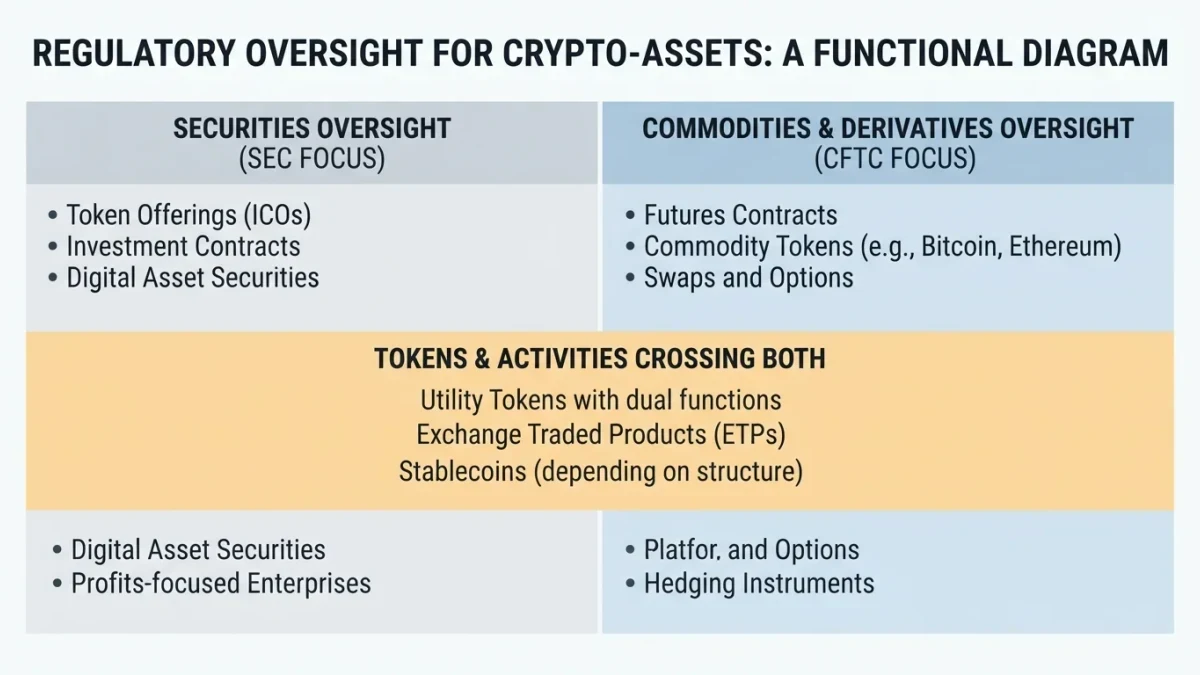
The SEC polices securities — stocks, bonds and investment contracts — while the CFTC polices derivatives and commodities, including bitcoin futures. Crypto sits across both lines: the same token can trade like a commodity on one venue while being sold as part of an investment contract elsewhere.
That overlap is exactly what the chairmen pointed at. "For too long, market participants have been forced to navigate regulatory boundaries that are unclear in application and misaligned in design," Atkins and Selig said in the joint announcement of January 22, 2026.
What actually happened at the January 27 event?
Talks, not rules. Per the SEC's announcement, Atkins gave an introduction, Selig delivered opening remarks, and the two chairmen then held a fireside chat moderated by journalist Eleanor Terrett. The event was open to the public, webcast on the SEC's website, and held at CFTC headquarters in Washington, DC.
The format matters for expectations: a joint public conversation is how agencies signal direction before anything formal exists. Nothing proposed at the event carried legal force — no rule was proposed, no case resolved, no date for either given.
Why does "harmonization" matter for a newcomer?
Because gaps between regulators become gaps in protection. When rules differ by agency and by product, the same activity — say, trading a token with leverage — can be fully regulated in one wrapper and nearly unregulated in another. Harmonization is the attempt to make those boundaries line up.
For beginners the practical translation is modest: clearer jurisdiction could eventually mean more consistent disclosures and fewer gray-zone products. It could also mean new restrictions on offerings that relied on the gray zone. Neither effect arrives from a meeting alone.
What is worth watching next?
Official documents, not headlines. Joint statements, proposed rules and memoranda between the agencies are the artifacts that change obligations — an event like this one is the preview, not the feature. The SEC's pressroom and the CFTC's pressroom publish both.
Until something is filed, the honest summary of January 27, 2026 is: the two chairmen shared a stage, agreed the current split confuses market participants, and told the public they intend to work on it. Intentions, in regulation, are the cheap part.